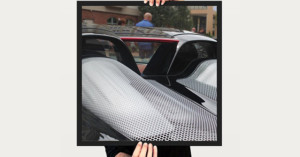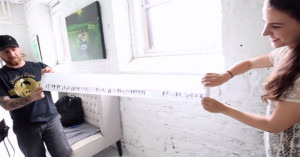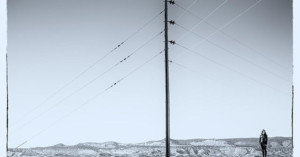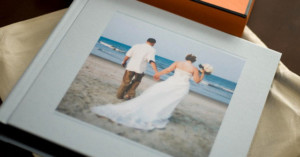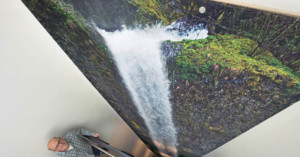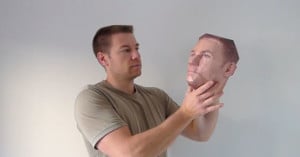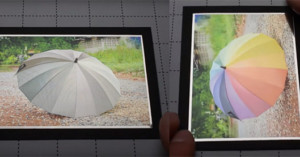
If you’re looking for a thrifty way to have gigantic (monochrome) prints made of your photographs, look no further than your local Staples. Monica and Jess of East Coast Creative write,
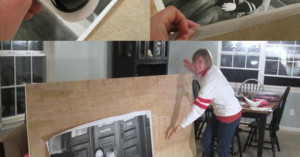
Have you heard about the engineer prints from Staples? Oh.My.Goodness. They have completely changed our life for the better. Just wait, you’ll feel the same way. Take your favorite picture into Staples and ask for an oversized print (they come in multiple sizes, but the largest is 3’ by 4’. They’ll make a copy right there for you, and the best part… it costs less than $5 for a print! You’re only able to get the picture in black and white, but who cares?! It’s 5 bucks! The tricky thing is that the picture is printed on very thin paper, so you have to be careful not to bend or mark it.
They’ve written up a tutorial on how you can make a giant DIY frame for these massive prints.
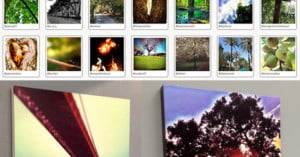
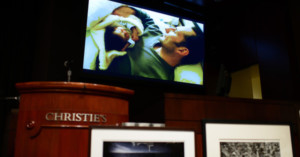
The Friends of Anton is an organization that has come together over the past year to ensure the future of slain South African photojournalist Anton Hammerl’s three children; and 3 days ago the organization in partnership with Christie’s held the latter’s first ever auction of contemporary photojournalism prints, raising over $100,000 towards their touching cause. Read more…
Instacanvas is a new service that helps Instagram users make money by selling their photographs as canvas wall art. Users can display their images through the “online gallery space” on the site, and sell their images to buyers as canvas prints without having to do any extra work. Instacanvas acts as the middle man, doing all the printing and shipping, and takes a 20 percent commission from sales. The prints start at $40 for a 12×12-inch canvas and go up to $80 for a 20×20-inch one. Photographers are paid via PayPal once they earn more than $100 in sales. Instagram users have bought into the idea: the service amassed over 4,000 users in the first 72 of beta testing.
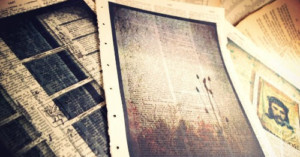
Etsy seller missquitecontrary sells her fine art photographs printed onto vintage dictionary pages. You can try your hand at doing this yourself — just be sure to use archival inks and find an old dictionary or encyclopedia with thick pages.
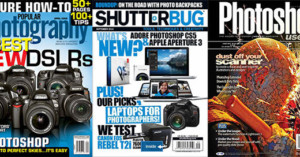
As newspapers and magazines struggle to keep eyeballs from turning to the free world of the Web, more and more blogs are rising up to fill the niches once dominated by print. Despite the changing landscape, magazines are still able to command high advertising rates that blogs can’t match (yet). Wanting to find out whether magazines or blogs provided the best bang of each advertising buck, photographer Trey Ratcliff recently spent $26,000 placing ads in three major photography magazines, comparing the results to his online affiliate ad returns. His conclusion?
If I was consulting for one of these product companies that puts significant funds into magazine advertising, I would challenge them to try something new for six months: Try taking 50% of that money and put it into several hundred blogs, podcasts and review sites and measure the results. Cut the worst performers and find new ones.
Only one of the three magazines actually made Ratcliff money (the other two lost over ten thousand dollars) — the one that included an online ad rotation as part of the package.
Want to made giant prints of your tiny phone photos? Instead of doing the enlargement purely with Photoshop, Photojojo suggests using a scanner for high-quality enlarging. Simply resample the small photo at 360dpi, print it out on high quality matte paper, and then re-digitize it using a scanner at 360dpi and the print size you want. It’d be interesting to see a side-by-side comparison of this technique versus simply resizing in Photoshop and printing that image directly.
Behind the Gare St. Lazare is one of French photographer Henri Cartier-Bresson‘s best known photographs, and is frequently cited as an example of his “decisive moment” approach to photography. The photograph was made in 1932, but the oldest known print is dated 1946. That print will be sold at a Christie’s auction on November 11th along with 100 other signed prints, and is expected to fetch up to ~$250,000.
Earlier this month we shared a hugely popular post on transferring a photo onto a block of wood. Well, the same technique can also be used to create a canvas print. All you need, besides the stretched canvas, is some gel medium and a photo printed with toner (e.g. made with a laser printer or photocopier). The gel medium is used to “steal” the toner from the paper, and once the paper is rubbed away, the print remains. Check out the full tutorial over on A Beautiful Mess.
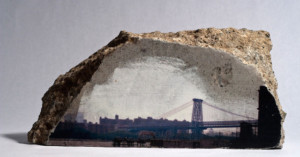
If printing your film photos with the usual chemicals isn’t old school enough for your taste, you should try your hand at making a salt print. Photographer Andrew B. Myers made the above print using the technique, and explains,
Salt printing is one of the oldest processes photography has employed, pioneered by Henry Fox Talbot back in 1839. The process hasn’t changed much since then. Basically, you start by coating paper in a solution of water and sodium chloride (I ended up using table salt) and letting it dry. Next, in a darkroom environment, a silver nitrate solution is applied to the salted paper, creating a light sensitive emulsion. Let it dry. At this point, a contact print can be made by sandwiching a film negative or some sort of transparency and letting the paper sit in the sun. In my case, I had access to a powerful UV light with a timer, which worked in a similar fashion, and allowed me to work at night in the winter. It’s quite neat seeing the image once it’s been exposed, and after washing and fixing, you’re done. [#]
Want to adorn a wall with a giant print using your own photography? Here’s a great video in which photographer Lee Morris shares how he shot, printed, and framed a massive 5-foot-wide panoramic print for less than $150 — super cheap compared to the $1,000+ you might pay to have it professionally done. After shooting multiple photos on a bridge in Rome, he merged the images using Photoshop, had a metallic print made by Bay Photo Labs, and then framed it using a large mirror he found at Bed Bath and Beyond. The final result is quite impressive!
Disclosure: Bay Photo Labs is a sponsor of PetaPixel