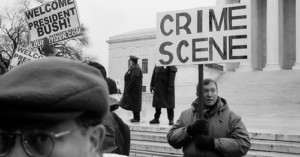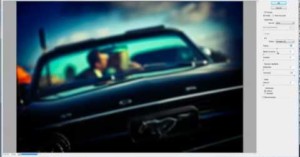
Pictures like this drive me nuts. I call it Meanwhile, Back at the Supreme Court. It captures the boisterous scene outside that building as right and left wing demonstrators clashed after the contested election of 2000. While all this was happening, President George W. Bush was delivering his first inaugural address in the background over loudspeakers. It was an exciting and historic experience to witness and document, but until now, I’ve never shown this image to anyone. As a matter of fact, it didn’t even exist until last night.
The reason? It’s fake. The moment it depicts never happened. Read more…
In a recent Photoshop blunder, North Korea’s Korean Central News Agency (KCNA) was caught distributing the above doctored photo of a marine military exercise involving hovercraft. The photo, which was originally distributed to several news outlets, claimed to show the prowess of North Korea’s marine force.
It didn’t take long, however, for several news agencies to start pointing out some anomalies that all indicated the photo had been doctored. Read more…
Skin care company Dove is speaking out on the issue of “fake beauty” being promoted in photographs through Photoshopping. Rather than address the issue directly at first, the company decided to speak out directly to those responsible for “fake” images by doing some clever guerrilla marketing. It essentially pranked retouchers through the Web by releasing a fake Photoshop beauty Action that undoes manipulation rather than creates it. Read more…
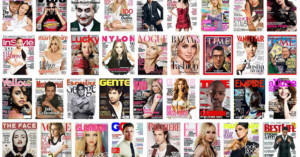
The New York Times has an interesting article examining how retouching has spread beyond fashion and advertising photos into editorial photography, conditioning the public to accept images that are “heightened versions of the truth”. One reason is pressure from celebrity subjects:
The demands of celebrities also drive this broader trend toward perfection. Mr. Granger said that he found more photographers are being pressured to produce shots that the actors or actresses like because celebrities then will request the photographer in the future for other magazine covers or for advertising work. That can be critical because editorial work alone is not enough to sustain a career in photography.
Ms. Greenberg said that in 2002 she shot Tom Cruise when he was wearing braces. She used Photoshop to remove the braces before submitting the photographs but the magazine asked her to put the braces back in.
“I was sad because I was like ‘now Tom Cruise is going to hate me,’ ” she said. Ms. Greenberg has not shot Mr. Cruise since then.
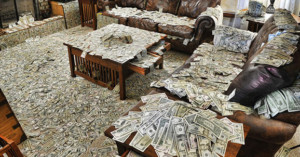
Evan Sharboneau over at Photo Extremist shot this crazy photograph of “a room filled with an obnoxious amount of money”. It wasn’t shot with a truckload of cash, nor was it created using CGI. Instead, Sharboneau used $871 in cash — a total of just 29 separate bills. He spent 4 hours photographing the room 170 times with the money placed in different locations in each frame, and then spent 5 hours merging all the photographs together in Photoshop. You can find Sharboneu’s video tutorial on this cloning technique here, and a tutorial we published a while back here.
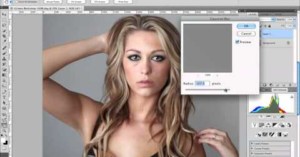
Here’s a Photoshop tutorial by Twin Cities Photography Group teaching how you can use Photoshop’s High Pass Filter to soften the skin on a portrait subject without losing the skin’s texture.
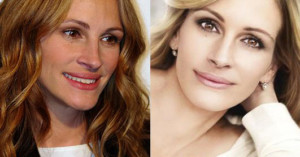
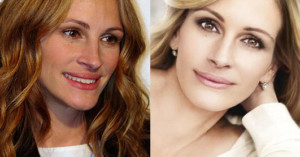
A Lancome advertisement featuring Julia Roberts caused a stir back in July after it was banned by the UK for being too “Photoshopped”. Now a couple in the US are trying to bring stricter regulation to the United States. Seth and Eva Matlins, founders of Off Our Chests, have started the Self Esteem Act:
We’re asking for support to pass federal legislation requiring advertising and editorial that’s meaningfully changed the human form through photoshopping or airbrushing to carry “Truth in Advertising” labels. The labels will simply state that the models shown have been altered. No judgments, no morality, just clarity.
[...] Photoshopping, airbrushing, digital manipulation isn’t the issue. The issue is too many look at these images and theink they should look LIKE these images. And they can’t…because they’re not real.
So let’s call a duck a duck and modified picture a modified picture. All we’re asking is that if you do it – you tell us you did.
They’re currently trying to raise 10,000 signatures for the petition, which can be signed here.
Advertising Standards Authority, the ad industry watchdog in the UK, has banned an advertisement by Lancome featuring Julia Roberts for being misleading, stating that the flawless skin seen in the photo was too good to be true. Parliament member Jo Swinson first brought the ads to the authority’s attention, and later told the BBC:
This ruling demonstrates that the advertising regulator is acknowledging the dishonest and misleading nature of excessive retouching. Pictures of flawless skin and super-slim bodies are all around, but they don’t reflect reality.
This comes about a month after the American Medical Association called upon ad agencies to stop the “altering of photographs in a manner that could promote unrealistic expectations of appropriate body image”.
The AP has sacked photographer Miguel Tovar for “deliberate and misleading photo manipulation” after Tovar cloned out his own shadow from a feature photograph. The Photoshopping came to light after an alert photo editor spotted a strange looking dust pattern in a photo of Argentinian children playing soccer. Read more…