Over the last month we’ve featured two re-interpretations of Robert Frank’s classic photo book “The Americans” — one controversial and minimalistic, another analytical. And now we bring you a third, very different, auditory take on Frank’s classic work.
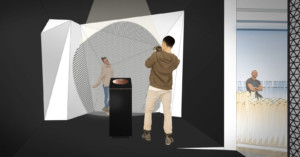
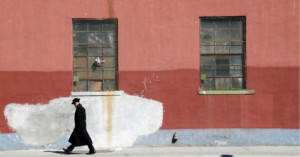
Photographer Andrew Emond‘s Sounds of the Americans is a re-interpretation of The Americans using sound. By using a specialized software to convert all 83 images into audio, and then using a spectrograph to take that audio and re-create the original image, Emond’s work sheds an entirely different light on iconic pictures we’ve all become very familiar with. Read more…
This behind the scenes video of Benjamin Von Wong‘s photo shoot with the band The Agonist is a great example of how creative band photography can really get when you have a band that’s willing to get dirty, paired with a phenomenal photographer. The video shows the process involved in taking a cool action shot band picture from idea to finished product, and should serve as great inspiration for anybody into band photography — or photography in general for that matter. Enjoy!
If you’re ever photographing a baby that’s sitting on anything above ground level, make sure you have a spotter near the baby at all times. This video shows why.

The 2012 Pulitzer Prize winners have been announced, and both winning photographers focused on the unbearable trauma of war. Massoud Hossaini of Agence France-Presse won the Breaking News award for his “heartbreaking image of a girl crying among a pile of dead bodies after a suicide bomber’s attack at a crowded shrine in Kabul.” Craig F. Walker of The Denver Post won the Feature Photography prize for chronicling “Colorado resident Scott Ostrom’s struggles with severe post-traumatic stress disorder after four years as a Marine Corps reconnaissance man and two deployments to Iraq.”
German broadcaster Deutsche Welle produced this interesting segment on photographer Yuri Arcurs and how he turned his microstock photography into a million-dollar photography empire. Here’s a mind-boggling statistic: on average, Arcurs sells one of his images every 8 seconds.

In November of last year, Steve Jobs’ official biographer Walter Isaacson revealed that Jobs had wanted to reinvent three things: television, textbooks, and photography. Last week Apple announced that it was reinventing textbooks with iBooks 2, which is intended to start a digital textbook revolution. The company is also rumored to be working on a Siri-enabled TV. Now, hints about what Steve Jobs wanted to do with photography are starting to emerge, and the murmuring is centered around one company: Lytro. Read more…

Perhaps inspired by the vintage camera nightlights we shared last year, photographer Laura Merz decided to upcycle her old Kodak digital camera by turning it into a nightlight for her house. She writes,
I took out all the tiny screws and gutted the camera very carefully as to not crack the exterior case. Be careful — some of the parts are pretty sharp. Removing the lens is the last step, and allows you to insert a small round night light through the opening. I had to crack off the exterior casing on the night light, but with a little force, it snapped right off.
It’s a creative way to breathe new life into an outdated or broken digital camera.
Ever wonder how the US government managed to capture spy photos with satellites during the Cold War without the help of digital cameras, computers, or wireless transmission? The Atlantic has a fascinating article on the various techniques that were used:
From 1971 to 1986 a total of 20 satellites were launched, each containing 60 miles (100 kilometers) of film and sophisticated cameras that orbited the earth snapping vast, panoramic photographs of the Soviet Union, China and other potential foes. The film was shot back through the earth’s atmosphere in buckets that parachuted over the Pacific Ocean, where C-130 Air Force planes snagged them with grappling hooks.
Here’s an interesting video in which acclaimed documentary filmmaker Errol Morris (the guy who directed The Fog of War) talks about the issue of truth in photography, and how he thinks we’ve forgotten that there’s a connection between photos to the physical world.
Photographs are neither truth nor false. Talking about the truth or falsit of a photograph is nonsense talk [...] All photographs are posed.
He also makes the point that sometimes photographs are posed by excluding things.
German photographer Andreas Gursky is one of the most successful artists of our time, and yesterday a print of his titled “Rhein II” became the world’s most expensive photograph, selling for $4.3 million. Back in the early 2000s, director Ben Lewis made this interesting 23-minute feature that gives an inside look into “Gursky World.”