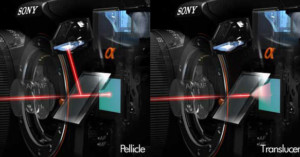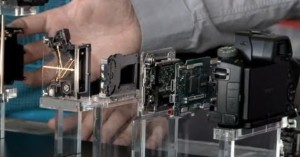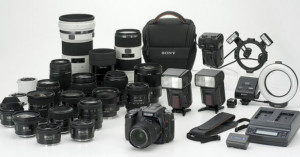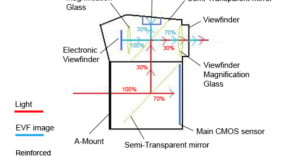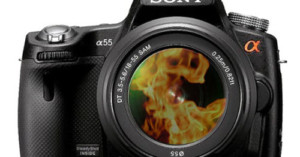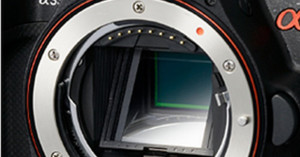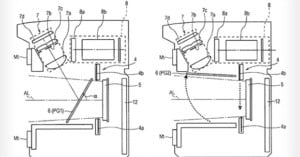
Most SLR cameras feature a mirror lock-up mode that allows photographers to eliminate the vibration (and blur) caused by the mirror flapping up and down whenever a shot is snapped. Sony’s SLT cameras don’t offer this when it comes to the pellicle mirror found inside — not yet, at least.
A Sony patent filed back in 2009 and published earlier this week shows that the company has been tinkering with the feature. sonyalpharumors is also hearing from a source that it’s something the next generation of Sony SLT cameras will offer. Read more…
A user over on the Chinese forum Xitek has leaked the first sample photographs captured using the Sony A99, the company’s upcoming flagship SLT (i.e. pellicle mirror) camera. The images are 100% crops of straight-out-of-camera JPEGs, with noise reduction completely turned off. Read more…
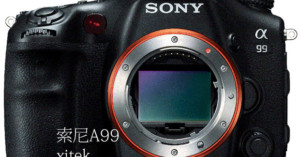
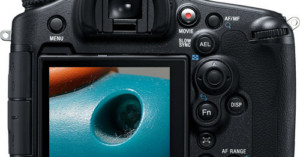
Here’s the first leaked photograph of Sony’s upcoming high-end full-frame single-lens-translucent DSLR, the A99. sonyalpharumors confirmed the authenticity of the image, which was first leaked onto the chinese website Xitek. We’ll likely be seeing the official announcement on Wednesday, September 12.
The A99 is designed to compete with high-end full frame DSLRs like the Canon 5D Mark III, and marks a departure from the optical viewfinders found in previous Sony full frame models — the A900 and A850. It’s the first pellicle mirror camera by Sony to feature a full frame sensor. It features a 24.3MP sensor, 10fps continuous shooting, 102 AF points (11 cross), a 3-inch tilting LCD, and in-body image stabilization. You can find some more specs in this post from last week.
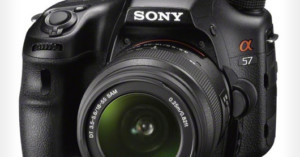
Sony has announced the Alpha A57 pellicle mirror camera, the successor to its A55 released a year and a half ago. While the sensor resolution is still 16-megapixels — no megapixel war here — the new camera has an increased ISO limit of 16,000 (up from 12,800), a faster continuous shooting rate of 12fps (up from 10), and an improved 15-point AF system with enhanced object-tracking and snappy AF during HD video recording. It can also capture full HD video at 60p, 60i, and 24p. It’ll be priced at $700 for the body only (or $800 with a 18-55mm kit lens) when it hits store shelves next month. Read more…
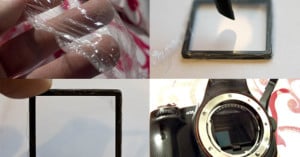
After damaging the pellicle mirror in his Sony A55 with cleaning fluid, a guy named Dario decided to look for a makeshift replacement while waiting for a real replacement mirror to arrive. He then discovered that food wrap (AKA Saran wrap) works nearly as well as a real pellicle mirror. The only downsides are occasionally degraded autofocus and a soft-focus effect when facing bright lights.
[...] “translucent” is just entirely—egregiously, blatantly—the wrong word. Translucent materials pass some of the light that falls on them and diffuse the rest. Muslin curtains, tracing paper, or frosted glass windowpanes in a bathroom are all translucent. An indistinct, fuzzy, or veiled image that’s hard to see is actually part of the definition of “translucent.” A pellicle mirror is a beam-splitter. That is, it passes some of the light transparently and reflects the remaining amount. There’s no translucency involved anywhere. Wrong word—and a bad connotation. Marketing fail? Heck, English language fail.
Wikipedia also notes that a “camera with a translucent mirror would produce an indistinct blob of light at the image plane.” A better word for people who might not know what “pellicle” means might be “semi-transparent”.
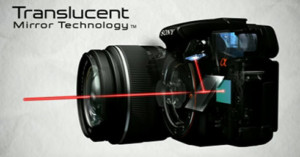
You’ve probably read plenty of articles touting the benefits of Sony’s translucent mirror technology (e.g. high fps, AF for video, quietness, etc…), but what about the cons? One of the main downsides to having a translucent mirror is that the light hitting the sensor passes through an additional layer (the translucent mirror), which reduces the amount of light and the image quality.
Ray over at TheSyberSite attempted to quantify how much the mirror affects the resulting image quality by removing the mirror on his A55 and comparing the resulting photos. He confirmed that about 1/2 stop of light is lost, and estimates that 5% of the detail in each shot is lost due to the mirror. Head on over to the article for some side-by-side comparisons.
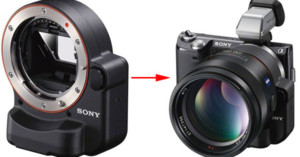
Lost in the commotion of Sony’s awesome camera announcements was the official unveiling of the LA-EA2 A-mount adapter, which we reported on a couple weeks ago. This fancy lens adapter lets you use Sony’s Alpha line of DSLR lenses with NEX mirrorless bodies without the loss of autofocus functionality by having a translucent mirror and autofocus system baked into the adapter itself!
Adding a large lens and electronic viewfinder to a NEX body leaves you with one strange looking camera, but the ability to use your existing lens collection on a new mirrorless camera is definitely a big deal (hopefully Canon and Nikon offer something similar if they announce mirrorless cameras soon). The LA-EA2 will cost $400 when it arrives in November.
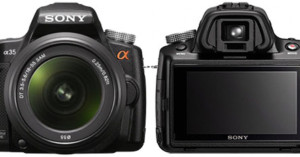
After photographs of the cameras were leaked back in April 2011, Sony has now officially announced its A35 translucent mirror camera to replace the A33 and the NEX-C3. The A35 has the same resolution as the A55 — 16.2 megapixels — and can shoot 1080/60 video and 7 frames per second for stills (though resolution is reduced to 8.4MP at this rate. ISO goes up to 25600, and there’s a large 3-inch touchscreen on the back. The A35 will be available in August for $600, or $700 if you want the standard 18-55mm kit lens included. Read more…