
Olympus Continues Freefall: Rumors of ‘Underworld Links’ and FBI Involvement
More news from the ongoing Olympus scandal: despite an official explanation …
More news from the ongoing Olympus scandal: despite an official explanation …

Update: Olympus has released an official response to the allegations.
Since Olympus abruptly fired CEO Michael Woodford (pictured, on left) four days ago, the company's stock price has fallen from roughly ¥2,480 to its current price of ¥1,417, a 43% drop that wiped out nearly $4 billion in value. As we reported yesterday, Woodford is now asking the UK to investigate the company's financial practices, and is claiming that he was booted when on the verge of exposing fraud.

Last Friday, we reported that Olympus had fired CEO Michael Woodford, claiming that he clashed with the …

Olympus fired CEO and President Michael Woodford today, causing the company’s stock price to take a 17% dive. The …

Last Friday, Olympus partnered with JetBlue for an Oprah-style giveaway: each of the …

Here’s another ad from Olympus’ Get a Real Camera campaign spotted by …
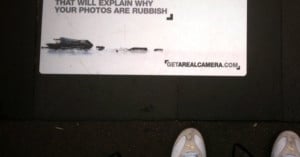
Photographer Mark Matthews of Sydney, Australia spotted the above plaque on a sidewalk …
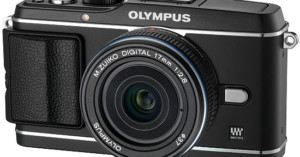
Olympus unveiled a boatload of Micro Four Thirds gear this morning, including three new PEN cameras, two new prime lenses, and a flash. All three cameras pack a 12.3 megapixel sensor with ISO that goes up to 12,800, a speedy new autofocus system (the "world's fastest"), and 1080i HD video recording. The E-P3 (shown above), the flagship camera of the PEN line, features an all-metal body, a pop-up flash, and an OLED touchscreen. It'll cost you $900 when it's out in August 2011.
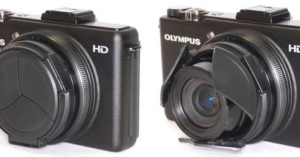
Check out this wacky-looking custom lens cap designed by Japanese corp UN for …
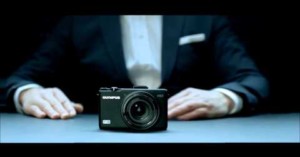
Olympus has a new "Spokesman Series" of commercials that try to convey the different strengths of their compact cameras in creative ways. They remind me a tiny bit of the Old Spice Guy commercials.
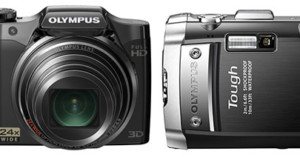
Olympus announced new compact cameras today. The SZ-30MR (on left) is the world’s first compact that can shoot both …
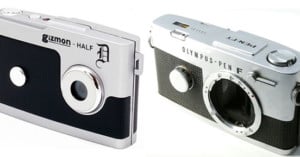
The Gizmon Half D is a digital toy camera by that mimics the …
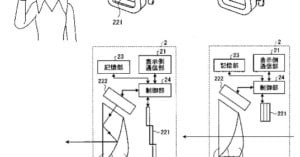
Olympus recently filed for a patent for this strange monocle-esque viewfinder system where …

Now here’s a clever idea: Olympus has filed a patent in Japan that allows you to use your …
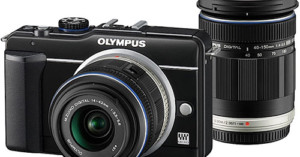
Olympus recently suggested that they would be going “all in” with EVIL cameras and pulling out of …
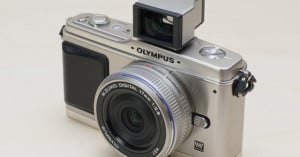
Olympus is ditching the entry-level DSLR in favor of its Micro Four Thirds mount PEN line of EVIL cameras. In an interview with Fotopolis, Toshiyuki Terada -- the Product Manager of Olympus' SLR Planning Department -- is quoted as saying,
We do not have concrete plans to replace the E-620 and other recent SLRs. The entry level SLR class can be completely replaced by the Pen system in terms of performance.
Later in the interview, Terada seems to say that leaving the DSLR market entirely is one of the company's goals.
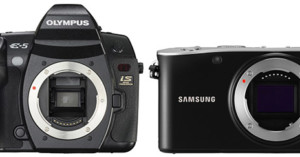
Looks like the rumors were dead on. Both the Olympus E-5 DSLR and Samsung NX1000 EVIL cameras have been officially announced by their respective companies with exactly the same design and specs that have been circulating the blogosphere. Camera makers haven't been doing a good job at keeping their news under wraps as of late.

The above teaser was leaked late last week, revealing that Olympus has a E-series DSLR announcement on September 15th. It is rumored to be the E-5, which will succeed their E-3 flagship DSLR, and comes about three years after the E-3 was announced. Rumored specs include a 12.3 megapixel sensor, HD (720p) video recording at 30fps, 5 fps shooting, in-body image stabilization, swiveling LCD display, 11 autofocus points, build-in wireless flash, and ISO that goes up to 6400.

Olympus recently filed a patent in Japan for a novel lens feature that shakes …
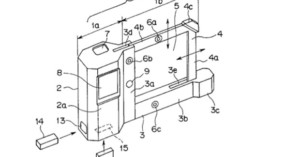
Canon may have revealed its plans for the Wonder Camera yesterday, but Olympus also quietly released something of its own to marvel at.
According to a newly published Olympus patent, originally filed in 2004, a new camera may be in development that is designed to make consumer point-and-shoots even more intuitive for casual photographers.
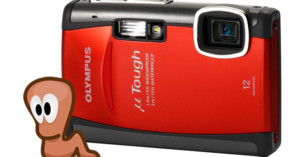
Olympus Japan released a notice to customers yesterday warning that 1,709 of their Stylus Tough 6010 point-and-shoot cameras were accidentally shipped preloaded with a worm. While the camera is not at risk, Windows users may be infected when the camera is connected to their computer via USB.

Olympus’ new commercial for the Olympus PEN E-PL1 is pretty typical, except that it has an interesting twist at …

Olympus just launched a new online publication called “PEN – The Magazine“. It’s …
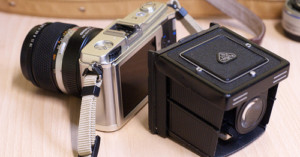
Hong Kong photographer Lok Cheung found that …
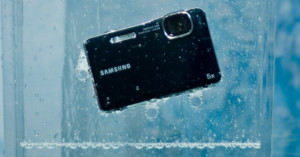
Underwater housing units for DSLR bodies can cost upwards of $1499 at most distributors. Waterproof cases for point-and-shoots already …
Last week Olympus began running a teaser …