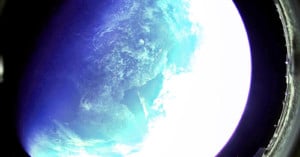
Camera on North Korean Missile Captures Earth from Space
North Korea's official state media has released a set of photos captured from space that it says were taken from a camera mounted on one of its missiles designed to deliver a nuclear warhead.
North Korea's official state media has released a set of photos captured from space that it says were taken from a camera mounted on one of its missiles designed to deliver a nuclear warhead.
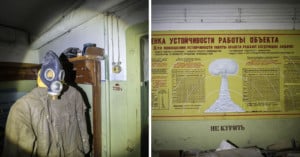
The Cold War is the conventional name for the period of political and military competition between two blocs led by the US and the USSR. This rivalry was mainly ideological and economic, intensified by the conventional and nuclear arms race.
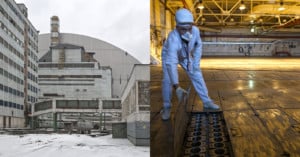
It’s been nearly 10 years since I first visited the Chernobyl nuclear power plant. It was a great experience for me. I could finally see the place I’d previously only known from books and TV and the tart taste of the Lugol’s iodine I had to drink a few days after the disaster.
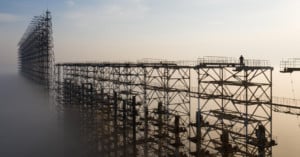
The DUGA over-the-horizon radar was one of the most important elements of the early warning system against an American nuclear attack on the USSR. More expensive to build than the nearby nuclear power plant, the complex consisted to two massive sets of receiving antennas located in Chernobyl and one transmission unit—which no longer exists—60km away in the town of Lubech-1.
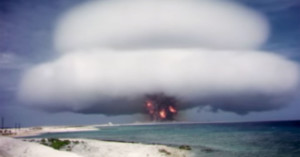
Between 1945 and 1962, the United States conducted 210 atmospheric nuclear bomb tests. For each of those tests, the government used multiple cameras filming at 2,400 frames per second to document things. Over 700 of the films have been declassified so far, and they're currently being uploaded to YouTube.
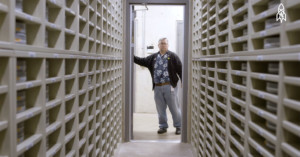
Here's a 3-minute video by Great Big Story about the National Audio-Visual Conservation Center in Culpeper, Virginia, a nuclear bunker that was once used by the Feds to house $4 billion worth of gold. Its goal these days is to preserve the nation's history of film.
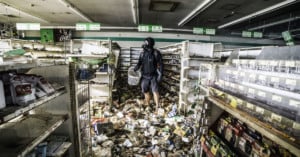
After the Fukushima Daiichi nuclear power plant was devastated by the 2011 Tōhoku earthquake and tsunami, the nuclear disaster caused a major evacuation and the creation of an exclusion zone around the old plant. Five years later, a photographer has ventured into the zone to deliver photos to the outside world.
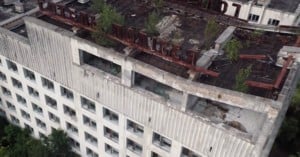
While working with CBS News to capture footage for a 60 Minutes segment about the Chernobyl Exclusion Zone, filmmaker Danny Cooke got to explore the haunted landscape there in a way most people haven't yet: by drone.
The resulting video, released just 4 days ago, is called Postcards from Pripyat, Chernobyl, and it's every bit as eerie as you would imagine.
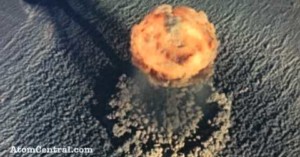
On November 5, 1951, a 31 kiloton atomic bomb was dropped in the Nevada Test Site from a B-45 Tornado bomber. A camera in the air was documenting the test, and captured the video above showing what a large nuclear explosion looks like when looking down at it from above. Notice how the camera begins to shake when the shockwave of the blast reaches it.
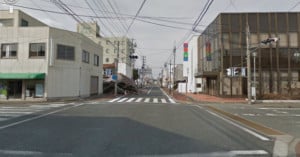
Due to the tragic Great East Japan Earthquake and the tsunami and nuclear disaster that it caused, the 21,000 residents of Namie-machi, Fukushima, Japan had to evacuate their homes. Even now, a little over two years later, the residual radiation makes it impossible for those former residents to return to the homes and businesses they were forced to abandon.
Still, many would like to see what has become of their town in the intervening years, and so Google teamed up Namie-machi mayor Tamotsu Baba to make that wish come true. As of yesterday, the displaced residents of Namie-machi (along with the rest of us) can tour the entire nuclear ghost town digitally.
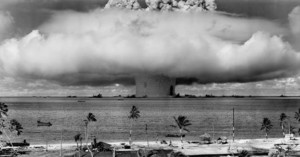
In in 1946, the United States conducted a series of nuclear weapon tests at Bikini Atoll in what's known as Operation Crossroads. A total of two bombs were detonated to test the effects nuclear blasts had on naval warships. The second, named Baker, was the world's first nuke to be detonated underwater. Due to the unique properties of underwater explosions, the Baker test produced a number of unique photographs that the world had never seen before.
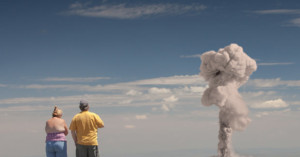
Atomic Overlook is a startling series of images by photographer Clay Lipsky that shows tourists enjoying the beauty of mushroom clouds at atomic bomb tests. Lipsky writes,
Imagine if the advent of the atomic era occurred during today's information age. Tourists would gather to view bomb tests, at the "safe" distances used in the 1950's, and share the resulting cell phone photos online.
Lipsky created the images by combining photos taken during his travels over the last 8 years with photographs of nuclear bomb blasts.
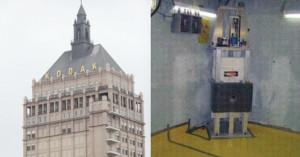
Many words and/or phrases come to mind when you think of Kodak: photography, disposable camera, Kodak moment, and more recently bankruptcy. But we never thought we would be able to associate the phrases "nuclear reactor" and "enriched uranium" with the once-great photography giant -- until recently that is. That's because a few months ago a former Kodak employee let slip to the Democrat and Chronicle the existance of a little known, and never publicized, nuclear reactor hidden in the bowels of Kodak city for the last 30 years.
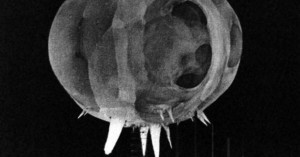
This might look like some kind of microscopic organism, but it’s actually a high-speed photograph of a nuclear explosion.