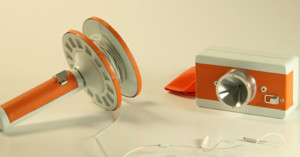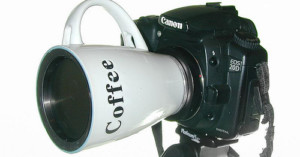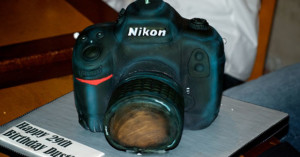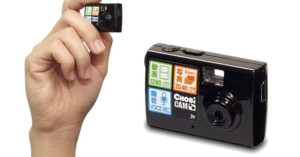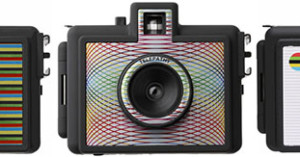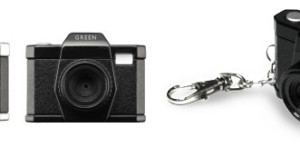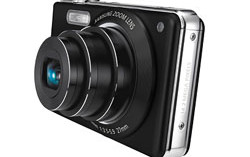
The Rolleiflex MiniDigi AF 5.0 is a tiny 5-megapixel digital camera designed to look just like the Rolleiflex 2.8F 6x6cm twin lens reflex camera. The camera even operates like an old school TLR: you look into the camera from above via a square 1.1-inch LCD screen, the camera needs to be readied for each shot by turning the handcrank on the side, and the photos taken are square format. It’s available on Amazon in black or red versions for about $270.
Thanks for the heads up, @jcargetsinger!

twine, the same store that sells the ceramic cameras we featured last week, sells these neat Polaroid-shaped beeswax candles. They give off a subtle honey scent, last for approximately 40 hours, and cost $38 a pop from the twine website.

Transforming foods into pinhole cameras appears to be one of the popular trends. We already shared the egg pinhole camera, and now here’s the pine nut pinhole camera. Italian photography student Francesco Capponi created this tiny camera by painting the inside of the shell black, poking a hole in one side, loading it with a piece of photographic paper, and using his thumb as a shutter. He calls it the “PinHolo”, a play on words since “pinolo” is Italian for “pine nut”.
Read more…

If you have an old or broken flatbed scanner lying around and gathering dust, a neat thing you can do is convert it into a cheap, do-it-yourself lightbox for viewing negatives and slides. Photo-enthusiast James Wilson did this as a weekend project:
It was a simple process; gut the scanner, hook up a light fixture inside it, and paint the inside of the glass white. Total cost was around ten bucks for the light fixture, wiring, and paint. [#]
You can read Wilson’s writeup here. There are also some additional photos over on Flickr.
This was one of my weekend projects (via Lifehacker)

Photographer Jamie Beck has a beautiful series of images that she calls “cinemagraphs“. They’re animated GIFs in which only a small piece each photograph is animated, making them a neat fusion of still and moving images. It’s amazing how much a tiny bit of movement in a still photo can do. They’re almost like the moving pictures you see in Harry Potter!
Read more…

Francesco Capponi was inspired yesterday (AKA Easter and World Pinhole Photography Day) to create pinhole cameras out of eggs. He painted the insides with emulsion to make it light-sensitive after drilling a hole, exposed it through a pinhole, then filled the egg with processing and fixing chemicals to develop the photo. You can find a full walkthrough of his process over on Lomography. The process isn’t easy — in creating four satisfactory photos Capponi ended up destroying fifty eggs!
The Pinhegg – My Journey To Build An Egg Pinhole Camera (via Make)

Check out this bizarre looking homemade medium format camera spotted by tokyo camera style on the streets of Tokyo, Japan. That bizarre glass bulb you see sticking out of it is the 360 degree lens that projects panoramic views onto the 120 film inside the camera.
Read more…
We covered the WVIL (wireless viewfinder interchangeable lens) concept camera at the beginning of the year when the design team behind it released a fake video of it being showed off at CES 2011. The above video is another neat glimpse at the supposedly patent-pending design, which puts all the camera functions in the lens itself, leaving the camera body to function as a wireless display and control panel. What do you think of the idea?
WVIL (via PhotoWeeklyOnline)

This 4GB USB flash drive looks exactly like a miniature Canon Digital IXUS 200 IS compact camera. Not sure whether it’s simply a concept design or something that’s actually available for purchase… Anyone know?
Update: Apparently Canon has given these out at press events in the past. Anyone know if these can be purchased?
Image credits: Photographs by One Paradox

When a fake camera technology is unveiled, it’s normally called a “concept”. When it’s published on April 1st, however, it’s called an April Fool’s Joke (e.g. last Friday’s Canon iPad monitor). The RE-35 is another fun idea that would be absolutely awesome if it actually existed — it’s a 35mm canister that transforms any 35mm film camera into a digital one using a flexible sensor. Simply load the canister into the camera as you would with film, shoot your photos, and download them by connecting to the canister via USB.