Yahoo made some management moves a couple of weeks ago, with VP Adam Cahan becoming head of the company’s mobile endeavors and it’s photo-sharing service, Flickr. Cahan was previously the founder and CEO of IntoNow, a 12-week-old company that Yahoo acquired last year for $20 to $30 million. Read more…
Contest is open only to individuals who have reached the age of majority in their jurisdiction of residence at the time of entry and who do NOT reside in Cuba, Iran, New Jersey, North Korea, the Province of Quebec, Sudan, Syria or Vermont. Employees of National Geographic Society, and its subsidiaries and affiliates [...] CONTEST IS VOID IN CUBA, IRAN, NEW JERSEY, NORTH KOREA, THE PROVINCE OF QUEBEC, SUDAN, SYRIA, VERMONT AND WHERE PROHIBITED.
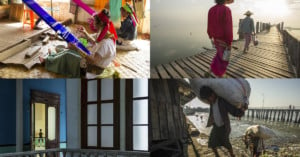
Iran and North Korea? Those are understandable… but New Jersey and Vermont? Turns out there’s a pretty simple answer for those states as well: state laws. Read more…
The photo above is the winning photograph in this year’s National Geographic 2012 Traveler Photo Contest. It’s a photo by Brooklyn-based photographer Cédric Houin titled “Butterfly”, which shows a Kyrgyz mother and daughter using a sewing machine in their dwelling. His caption reads,
This image was shot in the Kyrgyz lands of the Wakhan Corridor. The intimacy of this everyday life moment, shot inside of a family yurt, is in total contrast with the harsh environment these nomadic tribes live in. On the right we notice a television and a sound console. These tribes live weeks away from any village by foot. In spite of being located at an altitude of 4,300 meters in one of the most remote areas of Afghanistan they are equipped with solar panels, satellite dishes and cellphones. Ancestral ways of living, with touches of modernity.
The image was submitted into the category Sense of Place (the other categories were: Travel Portraits, Outdoor Scenes, and Spontaneous Moments). Read more…
Having just mentioned National Geographic yesterday, it’s appropriate that we’re featuring a photographer whose work has been used in the magazine many times over. David Doubilet is certainly one of the greatest underwater photographers in the world, and his work in both fresh and salt water, in both black and white and color, really leaves one breathless. Read more…
Last year we shared a table listing the various hazards National Geographic photographers experience while on the job. Of the 45 members surveyed, 8 of them had been attacked by wild animals. Here’s a video in which Nat Geo photographer Mattias Klum describes an experience in which he went face-to-face with a lioness, and escaped with both his life and an amazing photograph.
The Photo Society has published an interesting article in which Kent Kobersteen, the Director of Photography at National Geographic magazine from 1987 to 2005, shares thoughts on what he looks for in photographers:
[The required] attributes are intellect, passion, maturity and drive.
Reading this, you may say “What about the photography?” Of course any person under consideration must be a great photographer. The National Geographic needs photography that is strong aesthetically and has a sophisticated use of color, photography that is poetic, journalistic, memorable, and comes from unique and intuitive seeing. But, that’s obvious, that’s a given.
All four of these attributes – intellect, passion, maturity, drive — ARE about the photography.
Kobersteen also states that he would choose “a photographer whose eye was not the best, but who worked very hard, rather than the person with the best eye in the world, and who was lazy.”
National Geographic photographers get to do the coolest things. In this video, photographer Carsten Peter takes us along with him on a journey into Son Doong, the world’s largest cave located in Vietnam. The biggest chamber in the cave is over 3 miles long and more than four times taller than the Statue of Liberty.
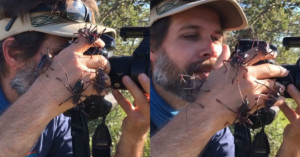
In a paper published in Science this week, Japanese researchers reported on a discovery that jumping spiders use a method for gauging distance called “image defocus”, which no other living organism is known to use. Rather than use focusing and stereoscopic vision like humans or head-wobbling motion parallax like birds, the spiders have two green-detecting layers in their eyes — one in focus and one not. By comparing the two, the spiders can determine the distance from objects. Scientists discovered that bathing spiders in pure red light “breaks” their distance measuring ability. Read more…
Ever wonder how the photographs found on the pages of National Geographic come together? Here’s a fascinating behind-the-scenes video showing how the images of the 1992 cover story titled “The Sense Of Sight” — photographed by Joe McNally — were shot, edited, and arranged. McNally writes,
And changes. Man, is that an understatement. High res digital cameras have replaced film cameras. Hard drives store pictures, not little yellow boxes. Kodak’s stopped making carousel projectors. Photographers go to the magazine far less often, given digital transmission. Ties and jackets are seen less frequently.
But, the main mission, over time, has remained. Tell a good story in pictures. The major components–photographer, picture editor, designer, magazine editor–are all still in place, and the interplay among them is ongoing and largely unchanged.
The next time you pick up an issue of National Geographic and are tempted to flippantly flip through the images, consider these crazy facts: the 40 page/40 picture story took roughly a year to create from idea to completion and required 1200 rolls of film shot during 6 months of field work!
One just doesn’t walk in off the street to get a job at National Geographic anymore. That was almost half a century ago when there were many more magazines being published that used good photojournalism. And the number of really fine photographers was not nearly as high as I believe it is today. So it’s much tougher to do what I did so long ago. But not impossible.
[...] I would never tell anyone you can’t get there from here, regarding getting to photograph for National Geographic. But, if that’s what you want, you have to want it really bad and dedicate yourself to developing your eye and photographic abilities to the very best you can, and then try to do even better than that. Don’t worry about being better than anybody you know personally or whose work you admire. Simply try to be better tomorrow than you were yesterday. You are not so much in competition with others as you are with yourself. Be your own toughest critic.