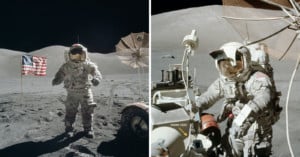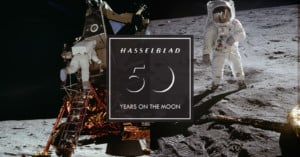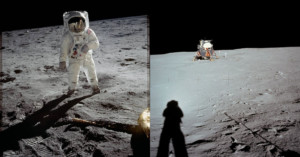
Between 1969 and 1972, NASA left 12 Hasselblad cameras on the moon to make room for moon rocks. One camera that wasn’t left there was a 16mm camera called the “Data Acquisition Camera” used during the Apollo 14 mission in 1971. It’s now in the center of a legal dispute between the US government and astronaut Edgar Mitchell, the sixth person to set foot on the moon. Mitchell claims that NASA allowed him to keep the camera as a souvenir after the mission, while NASA says that no evidence of this transfer ever took place. The camera was slated to be auctioned for an estimated $60,000-$80,000, but now NASA is suing Mitchell to get the camera back. The lawsuit states,
All equipment and property used during NASA operations remains the property of NASA unless explicitly released or transferred to another party.
Looks like those Hasselblads on the moon aren’t free for the taking after all. Shucks.
(via Reuters via Space)

Photographer Elias Politis created this beautiful image showing the June 15 lunar eclipse over the Acropolis in Athens, Greece by shooting a time-lapse video and then combining the stills into a single frame.
Read more…

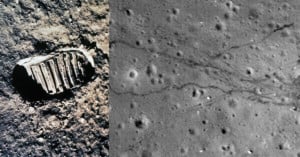
Last week we shared about how astronauts left some Nikon DSLR gear to burn up in the atmosphere instead of having it brought back to Earth, but it certainly wasn’t the first time cameras were left in space. Did you know that there are 12 Hasselblad cameras currently sitting on the surface of the moon? The cameras that shot those iconic images of the moon’s surface between 1969 and 1972 were left there to allow for the 25kg of lunar rock samples that were brought back instead. Only the film magazines were brought back.

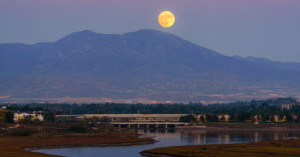
If you’ve been thinking of trying your hand at lunar photography, tomorrow night might present the perfect opportunity to do so. It’s when the Moon will be the closest it has been to the Earth in 18 years, making it 14% larger and 30% brighter than when the full Moon is furthest away. Miss this opportunity, and you won’t see a Moon like this until about 2029 — who knows what we’ll be shooting with by then!
Super Full Moon (via Harry Lim Photography’s Blog)
Image credit: Moon and trees by jpstanley

Landscape and architectural photographer David Kaplan captured this stunning photograph of the Moon and Venus rising above the village of Trübbach in Switzerland.
Sometimes a morning sky can be a combination of serene and surreal. Such a sky perhaps existed before sunrise this past Sunday as viewed from a snowy slope in eastern Switzerland. Quiet clouds blanket the above scene, lit from beneath by lights from the village of Trübbach. A snow covered mountain, Mittlerspitz, poses dramatically on the upper left, hovering over the small town of Balzers, Liechtenstein far below. Peaks from the Alps can be seen across the far right, just below the freshly rising Sun. Visible on the upper right are the crescent Moon and the bright planet Venus. Venus will remain in the morning sky all month, although it will likely not be found in such a photogenic setting. [#]
You can see this photo and others like it on Kaplan’s website and Flickr stream. NASA’s Astronomy Picture of the Day website has a large version of it too.
Moon and Venus Over Switzerland (via Boing Boing)
Image credit: Photograph by Dave Kaplan and used with permission

Now here’s a novel way to shoot the moon: stack five separate Canon 2x extenders to boost the focal length of your 800mm lens. Supposedly (and surprisingly) this rig actually captured a decent photograph of the moon.
This was done by the folks over at BorrowLenses, who also did the crazy filter stacking thing we featured recently. When you have as much gear as they do at your disposal, you have a wider range of ways to have fun with gear experiments.
Read more…
Last night there was a total lunar eclipse that just so happened to coincide with the Winter solstice. If you missed the eclipse in person, University of Floria professor and photographer William Castleman created this beautiful time-lapse video with photographs he captured from Gainesville, Florida.
(via Laughing Squid)

Believe it or not, the above photograph was made with an iPhone 4. jurilog created a tiny astrophotography kit using a small telescope you can buy online for ¥9,800 (~$115) and a miniature tripod mount.
Read more…