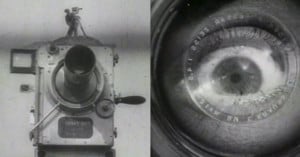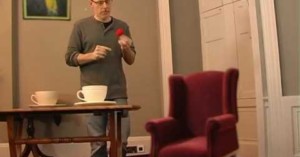
Whoa. If you enjoy watching mind-bending concepts that confuse you and make your brain hurt, check out this experimental short by Willie Witte, titled “Screengrab.”
Nothing in the video is computer generated trickery: it simply uses clever camera tricks and a whole lotta printed photographs to create the seamless transitions. “All the trickery took place literally in front of the camera,” Witte says. See if you can understand what’s going on through the entire 1 minute and 30 seconds. Read more…
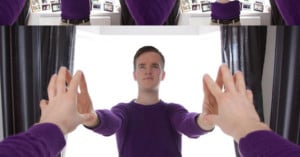
The video above is only 44 seconds long, but we’ll bet it’ll take up at least a minute and a half of your time — you’ll just have to watch it twice. It was created by British psychological professor Richard Wiseman, and demonstrates the power of perspective. It’s titled, “Assumptions.” Read more…
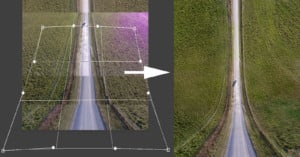
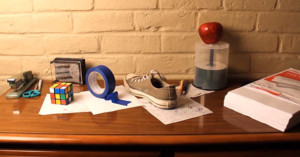
YouTube illusion and science channel Brusspup recently did an anamorphic illusion project in which he photographed a few random objects resting on a piece of paper (e.g. a Rubik’s cube, a roll of tape, and a shoe), skewed them, printed them out as high-resolution prints, and then photographed them at an angle to make the prints look just like the original objects. Read more…
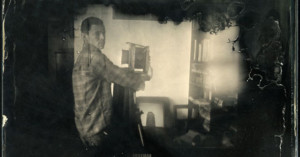
Last week we issued a challenge asking readers to shoot a creative mirror self-portrait using an alternative style of photography. Reader Agustin Barrutia took us up on that challenge, and created a pair of wet plate photographs that take the concept of “mirror self-portrait” to a new level (they’re unlike anything we’ve seen before). Both photographs are straight-out-of-camera wet plate photos that weren’t manipulated digitally. Barrutia simply used “mirrors” (one doesn’t involve a mirror, per se) and “reflections” in clever ways.
The wet plate above is a self-portrait of Barrutia shooting the wet plate. That camera in the frame is the camera that captured the wet plate. Read more…
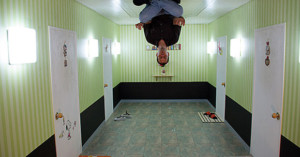
World travel bloggers Michael Powell and Jürgen Horn recently visited the The Trick Eye Museum in South Korea, where visitors can snap humorous and mind-bending pictures of themselves interacting with various painted rooms. They write,
If you don’t like having your picture taken, stay far away from the Trick Eye Museum, which is also not recommended for anyone who’s overly serious. Or those who have any semblance of pride. Basically, if you’re not willing to act like an idiot in front of the camera, you won’t have any fun here. But everyone else, and especially kids, should prepare for a good time.
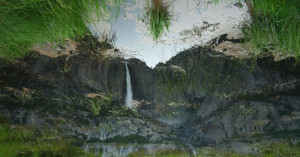
The entire point of this “museum” is to provide setups for funny pictures. An upside-down room makes it look like you’re standing on the ceiling. Stand in front of Mona Lisa with a paintbrush. Lay down on the floor and hang on for dear life to the painting of a cliff.
If you liked the the “impossible shot” from the film Contact that we shared earlier this week, you’ll enjoy this clip as well. It’s a shot from the film Sucker Punch that uses some clever camera work and trickery rather than CGI to create its mind-bending effect. Interestingly enough, both this clip and the Contact one feature actress Jena Malone (albeit at different ages).
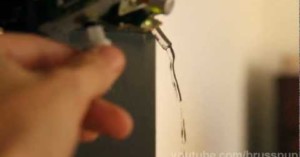
A couple weeks ago we shared an interesting video in which a speaker and Canon 5D Mark II’s frame rate were used to make water appear to be frozen in mid-air. This new video by YouTube user Brusspup takes the idea to the next level by making the water appear to travel upwards. He explains:
Fill a bucket full of water and place it about 5 feet off the ground. Place a subwoofer about 1 foot lower than the bucket. Run a plastic tube from the top bucket down in front of the subwoofer. Tape the tube to the front of the speaker. Then aim the end of the tube to an empty bucket on the floor. Get the water flowing from the top bucket. Now just generate a 24 hz sine wave and set your camera to 24 fps and watch the magic happen. Basically your cameras frame rate is synced up with the rate of the vibrations of the water so it appears to be frozen or still. Now if you play a 23 hz sine wave your frame rate will be off just a little compared to the sine wave causing the water to “move backward” or so as it appears. You can play a 25 hz sine wave and cause the water to move slowly forward.
This experiment has become quite a trend as of late — this particular video has been viewed over a million times in less than a week.
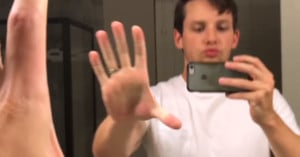
Snapping a self-portrait of oneself in a mirror is something every photographer has probably done before, but have you ever created one in which there isn’t a camera in the shot? The images look impossible, but they’re not too difficult to create using some careful planning and clever Photoshop trickery. Basically, all you need to do is photograph each arm and your head separately and then stitch the photographs together. Joshua Dunlop over at ExpertPhotography has published a tutorial on the technique.
Here’s something that’ll blow your mind (sorry that it’s an ad): stare at the colored dots on this girl’s nose for 30 seconds, then quickly look at a white wall or ceiling (or anything pure white) and start blinking rapidly. Congratulations, you just processed a negative with your brain!
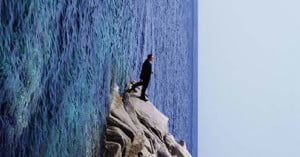
French artist Philippe Ramette captures surreal self-portraits in which he appears to be defying gravity. Rather than use digital trickery, Ramette — who started his career as a sculptor — builds metal support structures that allow him to stand or sit at impossible angles. Read more…