Posts Tagged ‘military’

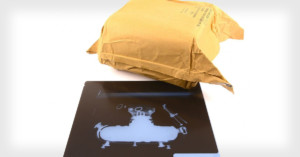
There Are Giant Camera Resolution Test Charts Scattered Across the US

There Are Giant Camera Resolution Test Charts Scattered Across the US

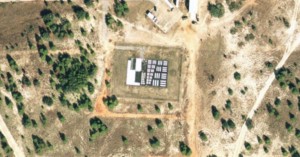
When people test cameras and lenses for resolution, they commonly use special resolution test charts that are filled with black bars of varying lengths and thicknesses. They’re kind of like eye charts, except for cameras instead of eyeballs, and with lines instead of letters.
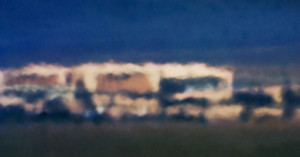
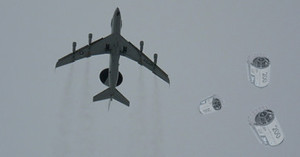
Well, did you know that in dozens of locations around the United States, there are gigantic resolution test charts on the ground?
Read more…

Snap Snap Snap: A Look Into the Mind of a Military Photojournalist

What’s it like to shoot on the front lines of battle as a military photojournalist? This 15-minute documentary by filmmaker Hannah Hill will tell you. Here’s the video’s description:

This is a documentary about Staff Sgt. Ryan Crane, a United States Air Force photojournalist, who has deployed to Afghanistan twice. He shares his experiences as a photojournalist in a combat environment as well as the mental and physical toll it takes on him.

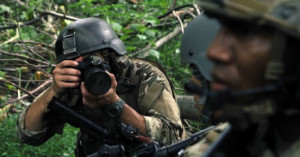
Crane is based out of O’Fallon, Illinois, and has served as a combat cameraman for a Special Forces, photographing the war with a DSLR and an M4.
Read more…

Trend: Professional Photographers Being Hired to Shoot Military Homecomings

Trend: Professional Photographers Being Hired to Shoot Military Homecomings homecoming1

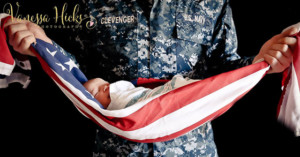
Professional photographers are often hired to capture moments in life that are memorable and emotional — two words that aptly describe military homecomings. The number of photographers hired to shoot homecomings is reportedly growing, as more and more families are hiring professionals to document the reunions that occur when soldiers return from war.
Read more…

Photog Snaps Pictures of Secret Military Bases Using Astronomy Telescopes

Photog Snaps Pictures of Secret Military Bases Using Astronomy Telescopes limit1

New York-based photographer Trevor Paglen‘s photos blur the lines between a number of fields, including art, science, and journalism. For his project Limit Telephotography, Paglen used powerful telescopes designed for astrophotography in order to see things that people aren’t supposed to: classified military bases.
Read more…

How US Spy Satellite Photography Worked Before Digital Technology

How US Spy Satellite Photography Worked Before Digital Technology spyplane mini

Ever wonder how the US government managed to capture spy photos with satellites during the Cold War without the help of digital cameras, computers, or wireless transmission? The Atlantic has a fascinating article on the various techniques that were used:

From 1971 to 1986 a total of 20 satellites were launched, each containing 60 miles (100 kilometers) of film and sophisticated cameras that orbited the earth snapping vast, panoramic photographs of the Soviet Union, China and other potential foes. The film was shot back through the earth’s atmosphere in buckets that parachuted over the Pacific Ocean, where C-130 Air Force planes snagged them with grappling hooks.

You can check out all the details of the super secret photography program in this now-declassified report.

Your Briefing on the CIA’s Cold-War Spy Satellite, ‘Big Bird’ [The Atlantic]


Image credit: Creepy Spy Plane by substack

A Night-Vision Lens Used by US Military Photographers

A Night Vision Lens Used by US Military Photographers nikonwar mini

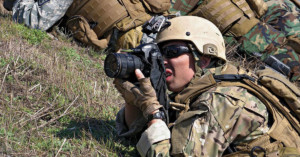
Think your lens is good in low-light conditions? Check out this Nikon D700 with a Nightstalker II night-vision system attached — standard issue for the Navy’s Combat Camera unit. PopPhoto has published an interesting article that offers a glimpse into what life is like as a US military photographer. You an also see an example photo shot with the above lens here.

Life as a US Military Photographer (via Nikon Rumors)

Hackers Create a DIY Flare Gun Camera

Hackers Create a DIY Flare Gun Camera flaregun

The Israeli army has a tactical intelligence device called the “Firefly” — a wireless camera that’s launched out of a grenade launcher, capturing eight seconds worth of imagery as it floats on a parachute from 500 feet in the air. It’s military grade technology that isn’t available to private citizens, but two hackers are trying to create a DIY version of the device for $500. Vlad Gostom and Joshua Marpet built their version of out of a 37mm flare gun, and showed it off this week at DefCon. They hope that, if perfected, the device could one day be useful for people ranging from law enforcement officers to search-and-rescue teams.

Build your own camera, launch it like a grenade (via PopSci)


Image credit: Photograph by Robert McMillan/TechWorld

Nikon D200 on Steroids: Tactical Camera Long Range Assault Stock

Nikon D200 on Steroids: Tactical Camera Long Range Assault Stock talc1

This crazy looking camera-gun is actually a Nikon D200 attached to a rifle stock. The Tactical Camera Long Range Assault Stock (TALCS, not sure why it’s not TCALRS) has a trigger that activates the camera’s shutter, allowing you to shoot photographs just like you would shoot a gun. Read more about the background and construction on this forum post.

Tactical Camera Long Range Assault Stock [TALCS] (via Weekly Drop)

Photo Pulitzer Prize Winners: Mary Chind and Craig F. Walker

Photo Pulitzer Prize Winners: Mary Chind and Craig F. Walker mugsPhotojournalists Mary Chind of The Des Moines Register and Craig F. Walker of The Denver Post won Pulitzer Prizes this year in photography.

Chind’s photo of a harrowing water rescue photo won as the Best Breaking News Photograph. The photo, published July 1, 2009, shows a construction worker dangling above the rapids of a dam, in an attempt to reach a victim in the water. The Pulitzer board say the photo captured “a heart-stopping moment.”

The victim and her husband had gone over the edge of the dam on a boat. Rescuers could not reach the pair with a crane. According to the National Press Photographer Association, Chind took the photo from a nearby bank crowded with rescue workers and firefighters. A worker in a makeshift rig was lowered down towards the water and managed to save the woman after several attempts.

Photo Pulitzer Prize Winners: Mary Chind and Craig F. Walker rescue

Walker won the Best Feature Photography for his intimate photo essay of a teenager, Ian Fisher, as he entered the Army. Walker documented the young man for 27 months, following him as he recruited, trained, was deployed to Iraq, and finally returned.

The Pulitzer board described Walker’s work as “an intimate portrait of a teenager who joins the Army at the height of insurgent violence in Iraq, poignantly searching for meaning and manhood.” Color versions of Walker’s essay can be seen on the Pulitzer website and the multimedia package can be seen on the Post’s website.

Photo Pulitzer Prize Winners: Mary Chind and Craig F. Walker walker


Image Credits: River Rescue in Downtown Des Moines by Mary Chind and American Soldier by Craig F. Walker

Grim Military Footage Reveals Death of Two Reuters Employees

Grim Military Footage Reveals Death of Two Reuters Employees screencap

A video released on WikiLeaks.org shows disturbing footage taken in 2007 from an American apache helicopter as they circle and fire upon a group of people they identify as armed hostiles in the street.

As it turns out, the two men who appear to be armed are actually working Reuters employees: photographer, 22-year-old Namir Noor-Eldeen, and his driver, Saeed Chmagh, who was 40. The two men were walking in the street with camera straps hanging from their shoulders. One of the men has a long lens, misidentified as an RPG.

According to a New York Times article published yesterday, Reuters had heard of a military raid in the area — the same raid that the military was attending to, and the two men went to investigate. Their mere proximity to the raid proved to be fatal.

The military fired upon the men and other individuals, who were later confirmed to be civilians, among them two children and the two Reuters employees. The attack killed 12, including Noor-Eldeen and Chmagh.

In a United States Central Command report:

“[The men] made no effort to visibly display their status as press or media representatives and their familiar behavior with, and close proximity to, the armed insurgents and their furtive attempts to photograph the coalition ground forces made them appear as hostile combatants to the Apaches that engaged them.”

Reuters news editor in chief David Schlesinger said in a statement:

“The deaths of Namir Noor-Eldeen and Saeed Chmagh three years ago were tragic and emblematic of the extreme dangers that exist in covering war zones. We continue to work for journalist safety and call on all involved parties to recognize the important work that journalists do and the extreme danger that photographers and video journalists face in particular.”

(via New York Times)