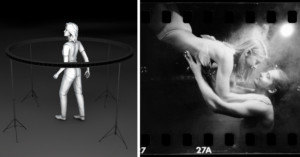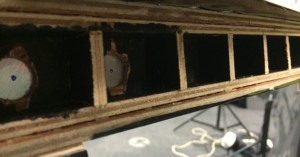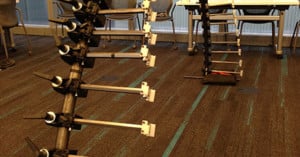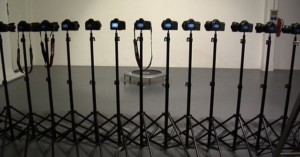
Want to shoot insanely cool Matrix-style “bullet time” footage at home? You can do so with a single rig built out of relatively cheap components.
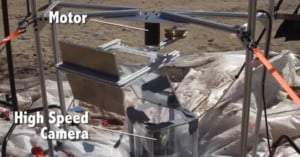
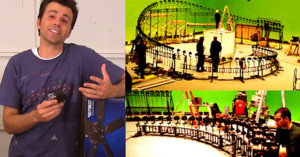
NASA spaceship engineer Mark Rober came up with a brilliant way to shoot eye-popping imagery using just a GoPro camera and a cheap ceiling fan. Read more…
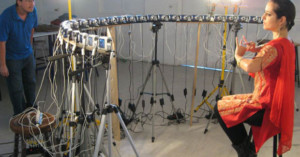
Chilean visual artist Felipe Baeza is doing some pretty interesting work with Matrix-style camera rigs. Instead of bullet time videos, Baeza uses his rig to create 3D portraits of subjects that can then be displayed in augmented reality or through a 3D model viewer. Read more…
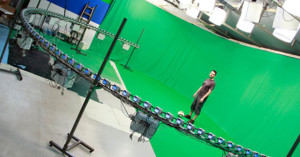
Back in March, a client for whom I’ve done some light consulting work asked me if it was possible to capture a 360-degree-image that can be rotated afterwards. I said of course, but didn’t think that much about the consequences — it’s a project that would wake me up at nights for the next few months. Read more…
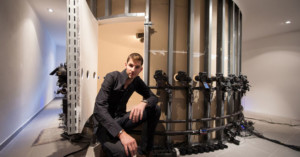
For their project 24×360, Patrick Rochon, Timecode Lab, and Eric Paré combined a 360-degree “bullet time” rig with light painting and produced some pretty sweet results. The short teaser above shows some of the pieces they created. Read more…
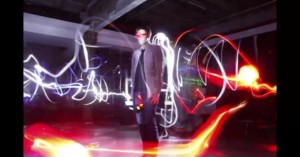
Light painting and bullet time are both amazing photographic techniques on their own, but what happens when you combine them? The amazing video above by Richard Kendall and his team shows just that: three dimensional light painting captured with a 360-degree Matrix-style bullet time camera rig. The results are stunning.
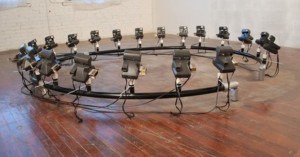
Line up an array of digital cameras and you’ll have yourself a setup that can take Matrix-style bullet-time shots. Artist Sam Blanchard created a similar rig, but went with Polaroid cameras instead of digital ones. The project, titled Polaroid Matrix, consists of 20 Polaroid cameras arranged in a circle and modified to be triggered remotely. After the cameras are triggered to simultaneously capture photos of the subject in the center, the Polaroid pictures are arranged and turned into a Flipbook. Read more…
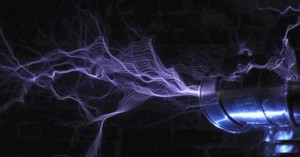
Hacker Rob Flickenger wasn’t satisfied with ordinary photographs of his ongoing Tesla coil experiments, so he decided to shoot Matrix-style “bullet time” images to capture “3D lightning”. He purchased 10 Canon A470 cameras and configured them to function as a single 70-megapixel 10-angle camera.
Why that particular camera? Partly because I found someone dumping a bunch of them on eBay for cheap, but also because they run CHDK, the infamous scriptable firmware for Canon cameras. This let me write some code to streamline the process of taking ten photos all at once, and then get them off of the cameras in a reasonable manner. By wiring all of them to the same 10-port USB hub, and using CHDK’s syncable USB remote feature, I was able to wire up a single button to make all of the cameras fire at once.
His hard work paid off, and Flickenger managed to capture some pretty unique shots of his Tesla coil in action.
To capture “portraits of the sun” and to illustrate its power, General Electric filled 20 weather balloons with hydrogen and helium, surrounded them with 24 Canon DSLR cameras (18 7Ds and 6 60Ds), and shot the balloons exploding Matrix-style.