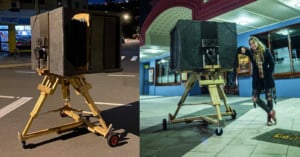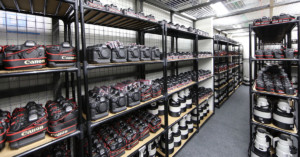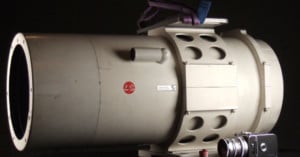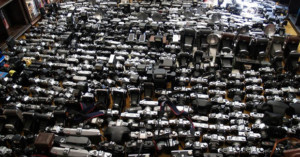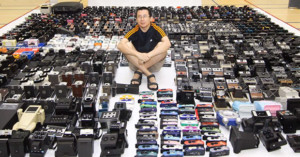
Want to own a giant collection of vintage cameras, but don’t want to spend a lifetime acquiring them one by one? If you have deep pockets and money to burn, here’s your shot: collector Brain Cue of Alameda, California (kka20101 on eBay) is selling his massive camera collection that he has spent over 50 years building up.
Read more…

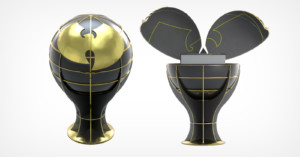
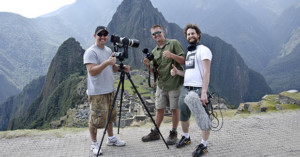
Photographer Jeff Cremer recently captured the highest-resolution photo ever shot of Machu Picchu, the most popular tourist destination in Peru and one of the New 7 Wonders of the World. Unlike other gigapixel projects that we’ve shared here in the past, this one is very well documented, offering an interesting behind-the-scenes look at how these gargantuan images are made.
Read more…
-
Roger Cicala · Oct 17, 2012
-

SigZilla is gone now. You’ll be able to see its work in action if you watch the World Series. I wouldn’t be surprised if you catch a glimpse of it mounted to FOX’s Vision Research camera. Before it left, though, we were able to — with a great deal of difficulty — get it mounted in the lab and run one basic Imatest series.
Read more…

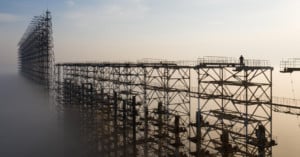
Gigapixel photographs are generally created by snapping a large number of photos of a scene using a special robotic camera rig, and then stitching those images together afterward using special software. Jean-François Rauzier creates similarly massive images, except his “hyperphotos” are all stitched together by hand.
Read more…

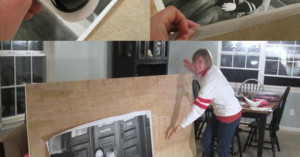
If you’re looking for a thrifty way to have gigantic (monochrome) prints made of your photographs, look no further than your local Staples. Monica and Jess of East Coast Creative write,
Have you heard about the engineer prints from Staples? Oh.My.Goodness. They have completely changed our life for the better. Just wait, you’ll feel the same way. Take your favorite picture into Staples and ask for an oversized print (they come in multiple sizes, but the largest is 3’ by 4’. They’ll make a copy right there for you, and the best part… it costs less than $5 for a print! You’re only able to get the picture in black and white, but who cares?! It’s 5 bucks! The tricky thing is that the picture is printed on very thin paper, so you have to be careful not to bend or mark it.
They’ve written up a tutorial on how you can make a giant DIY frame for these massive prints.
Shaped Frame Family Photo [East Coast Creative]
Image credits: Photographs by Monica and Jess of East Coast Creative

Back in September we featured a project called This Was Found that promotes art by leaving framed prints out and about in the UK. Now, printing company Jondo is taking it to the next level with a project called Art Heist. They’ve left 26 gigantic, museum-quality 40x60inch canvases in various secret locations around Los Angeles. Find one, and you’re free to take it home. Just make sure you have a good way of bringing home the massive photo!
Read more…

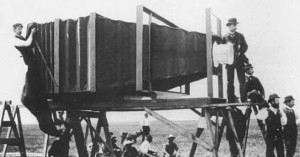
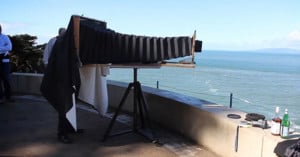
The record for world’s largest camera is currently held by an aircraft hangar camera, but back in 1900, a photographer by the name of George R. Lawrence built the massive camera seen above. He was commissioned by the Chicago & Alton Railway to shoot the world’s largest photo of one of its trains — a photo measuring 8 feet by 4.5 feet. The camera weighed 900 pounds, required 15 men to move and operate, and cost a whopping $5,000 — enough money back then to buy a large house.
The Mammoth Camera of George R. Lawrence [Simon Baker]

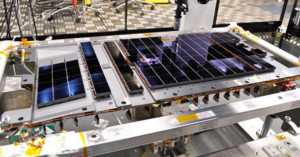
A 268-megapixel sensor might suffice for photographing the stars through a telescope, but apparently a sensor many times more powerful is needed for photographing alien planets from space. The European Space Agency has just finished building the largest camera ever to be used in space: a camera over three feet wide with a gigapixel sensor composed of 106 separate CCD sensors. Just to give you an idea of how powerful the camera is: it will be able to measure the width of a strand of hair from over 600 miles away, and the thumbnail of someone standing on the moon.
Read more…

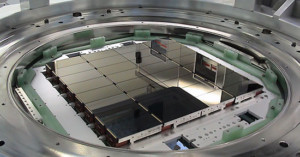
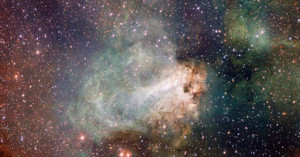
Last week we shared the beautiful first space photo to be taken with the OmegaCAM, a 268-megapixel, 1,700-lb camera operated by the European Southern Observatory. Here are some photographs of the camera itself, which uses an array of 32 separate CCD sensors for its incredible resolution.
Read more…

Amateur astronomy enthusiasts may be content with shooting the stars with a DSLR through a telescope, but what would a consortium of astronomy institutes use for photographing the night sky? The answer is the OmegaCam, a giant 1,700-lb camera found at the heart of the largest telescope designed for visible light surveying: the VST. It uses 32 separate CCD sensors that work together to form a giant 268-megapixel sensor, capturing 30 terabytes worth of photographs every year. The photograph seen above is the first released photo shot with this massive camera.
(via PhysOrg via Engadget)
Update: We’ve posted some photographs of OmegaCAM here.