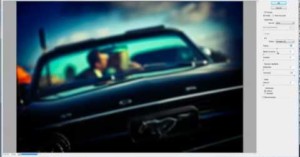
There’s plenty of tutorials out there teaching you how to fake the “Lomo effect” using Photoshop, but most of them don’t provide very realistic results. This “ultimate” tutorial by SLR Lounge attempts to mimic all the distinct characteristics of lomo photos (e.g. cross-processed colors, vignetting, blown highlights, and blurred edges) giving you a level of control over the results that an iPhone app could never do.
Redscale is a technique where film is exposed on the wrong side — rather than having the light hit the emulsion directly, you expose the film through the non-sensitive side.
The name “redscale” comes because there is a strong color shift to red due to the red-sensitive layer of the film being exposed first, rather than last (the red layer is normally the bottom layer in C-41 (color print) film). All layers are sensitive to blue light, so normally the blue layer is on top, followed by a filter. In this technique, blue light exposes the layers containing red and green dyes, but the layer containing blue dye is left unexposed due to the filter. [#]
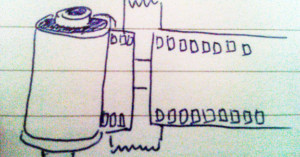
The two main ways for doing this are loading the film upside down (if your camera allows it), or by purchasing film that has been “converted” already. A third way is to make DIY redscale film by going into a darkroom, pulling out the film, cutting it, flipping it, taping it back together, and then winding it back into the canister. Messy, but it works! Read more…
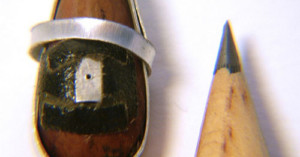
Transforming foods into pinhole cameras appears to be one of the popular trends. We already shared the egg pinhole camera, and now here’s the pine nut pinhole camera. Italian photography student Francesco Capponi created this tiny camera by painting the inside of the shell black, poking a hole in one side, loading it with a piece of photographic paper, and using his thumb as a shutter. He calls it the “PinHolo”, a play on words since “pinolo” is Italian for “pine nut”. Read more…
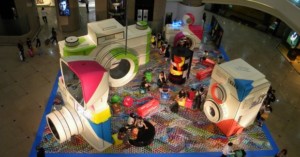
Lomography has a huge exhibition going on in Hong Kong’s Times Square shopping center featuring 40,000 Lomo photographs, massive film cartridges, and giant cameras loaded with trampolines. Read more…
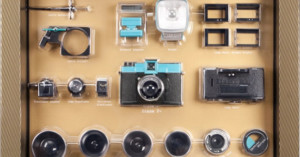
Lomography just announced this new Diana Deluxe Kit, which allows you to buy a complete collection of Diana toy camera goodies for a discounted price. Like many of the things we feature here on this blog, we think this looks a little too nice to use. You should just keep it framed and hang it up on your wall!
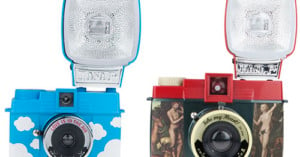
Valentine’s Day is just around the corner (February 14th, to be exact), and if the special person in your life is a photography-lover, you might want to think about ditching the cards, flowers, and chocolates, and going with something a little more… lomo. Lomography has released two special edition Diana cameras for this special occasion. The “Love is in the Air” Diana Mini costs $119 and the “Take My Heart” Diana F+ costs $99.
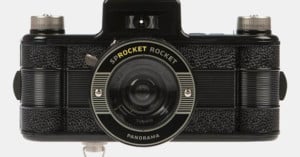
The Sprocket Rocket is a new analog camera by Lomography that the company claims is the first camera dedicated to sprocket hole photography. The sprocket holes of 35mm film are included in each panoramic exposure, giving the resulting images a unique look. Two knobs on the camera wind the film in both directions, allowing you to create multiple exposures images as well. Read more…
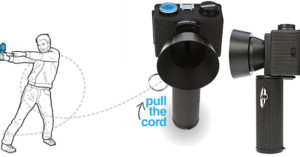
The Spinner 360º is a new plastic camera by Lomography that lets you capture 360 degree panoramas on strips of 35mm film.
Shooting involves turning the camera on the handle, which exposes the film through a vertical slit while advancing he film at a speed that synchronizes it with what you’re capturing. You can either turn the camera by hand for longer exposure shots, or use the pullstring built into the handle.
Here are some example panoramas taken with the camera:
Eight panoramas can be captured on each roll, with the image covering even the sprocket holes. The camera is available from the Lomography store for €125.00, or about $150.