Posts Tagged ‘legal’

If a Kid Grabs Your Camera and Snaps a Photo, Who Owns the Copyright?

If a Kid Grabs Your Camera and Snaps a Photo, Who Owns the Copyright? stranger mini

If a stranger suddenly grabs your camera and takes a photograph, who owns the copyright to that photograph? Photographer Mirjam Letsch writes,

Walking in an Indian bazaar, my Nikon dangling on my shoulder, this boy quickly clicked five times. I really liked the creative result when I later saw these images! Don’t know who owns the copyright though!

This might seem like a pretty farfetched example, but what about a case where you carefully set up and compose a fine art photograph, then for some reason ask a stranger to press the shutter for you?

In just five clicks! (via Techdirt)

Photos, Copyrights, and the “Mechanical Representation of Facts”

Photos, Copyrights, and the Mechanical Representation of Facts lachavsrhianna

The debate over David LaChapelle copyright infringement lawsuit against Rhianna rages on — lawyer John William Nelson has written an article on why copyright should extend only to the literal copying of a photograph and not the elements within the photo:

A photograph is a mechanical representation of facts. This is unlike a painting, which is a non-mechanical representation of something—be it facts, such as an attempt to paint an outdoor scene or create a portrait of someone, or imagination in the form of how the artist sees the world, such as the Vincent van Gogh’s Starry Night painting. Paintings, therefore, are pure expressions of ideas or facts. Photographs, however, are mechanical expressions of facts.

[...] extending copyright protection beyond the mechanical copying of a photograph (i.e., scanning it and sending it to all your friends) is extending copyrights in photographs too far. The expression of a photograph cannot be separated from its factual reproduction of actual events. Attempting to do so leads to absurd results.

Therefore, a bright-line rule should reserve copyright protection in photographs only for the reproduction of those photographs. Copyright protection should not extend to the elements within the photographs themselves—doing so results in copyrighting facts, which is beyond the scope of copyright law.

It’s a pretty length piece, but well worth a read. What’s your opinion on this issue? Should the elements within a photograph be covered by copyright protection?

Photography Copyright, Rihanna, And Why We Need a Bright-line Rule (via Techdirt)

News Photographer Arrested for Filming End of Police Chase from Sidewalk

Freelance news photographer Phil Datz was recording the conclusion of a police chase from the opposite sidewalk last Friday when he was confronted by a police officer and commanded to “go away”. Though he politely obeyed and moved a block further from the scene, the officer decided to arrest him for “obstruction of governmental administration”. The latest news is that the department is planning to drop the charges and put its officers through “media relations training”.

(via Poynter via Gizmodo)

Photos Must be the Product of Human Authorship to be Copyrightable

Photos Must be the Product of Human Authorship to be Copyrightable 4516094498 63cfb0ff05

Here’s an update to the whole monkey copyright story that’s been swirling around the blogosphere as of late: TechDirt points out that works that aren’t the product of human authorship cannot support a copyright claim. Section 503.03 of Compendium II of Copyright Office Practices published by the US Copyright Office reads:

503.03 Works not capable of supporting a copyright claim.

Claims to copyright in the following works cannot be registered in the Copyright Office:

503.03(a) Works-not originated by a human author.

In order to be entitled to copyright registration, a work must be the product of human authorship. Works produced by mechanical processes or random selection without any contribution by a human author are not registrable. Thus, a linoleum floor covering featuring a multicolored pebble design which was produced by a mechanical process in unrepeatable, random patterns, is not registrable. Similarly, a work owing its form to the forces of nature and lacking human authorship is not registrable; thus, for example, a piece of driftwood even if polished and mounted is not registrable.
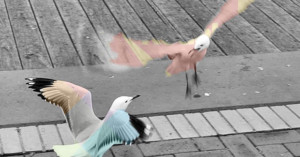
Is a photograph taken by a monkey the product of human authorship? On one hand, the monkey pressed the shutter, but you also can’t argue that a human author didn’t contribute, since they had to have provided the camera in the first place (unless the monkey stole it or something…). TechDirt believes the photos are in the public domain.

(via TechDirt via Boing Boing)


Image credit: Driftwood Eagle by Port of Tacoma

Getty Lawyers Say Google+ Terms Okay

Getty Lawyers Say Google+ Terms Okay google+

A little update to the recent brouhaha over Google+’s Terms of Service: Tom W of Getty Images posted the above message to fellow Getty members on Flickr informing them that Getty’s lawyers have no problems with the ToS. He writes,

The important thing to watch out for in Terms of Service, and it’s the same as we’ve talked about for contests, is that whatever they do (or allow third parties to do) with the images should be in the context of the service itself, not to re-license or otherwise commercialize the images to other parties (or even the main company itself) outside of the context they’re posted for.

Certain people have argued that uploading your photos to Google+ may hurt your ability in the future to sell exclusive licenses to images. If that’s what you’re worried about, it’s probably safer to keep your photographs off the Internet completely, since every content sharing service on the Internet requires at least a license to display your photos using their service.

(via ReadWriteWeb)

At What Point Does Inspiration Turn Into Copyright Infringement?

At What Point Does Inspiration Turn Into Copyright Infringement? inspiration

At what point does inspiration turn into plagiarism? That’s the question that popped up last year when Rhianna was sued by David LaChapelle over scenes found in one of her music videos, and it’s the same issue with a lawsuit recently filed by photographer Janine Gordon against photographer Ryan McGinley. Gordon claims that 150 of McGinley’s images — including some used for a Levi’s ad campaign — are “substantially based” on her photos. In the three pairs of disputed images shown above, the ones on the left are by Gordon and the ones on the right by McGinley.
Read more…

Tech Blog Receives Takedown Request Over Photos Monkey Took

Tech Blog Receives Takedown Request Over Photos Monkey Took techdirt

Just as the monkey photography story was dying down, a new twist emerges: on Monday tech blog TechDirt received an email from Caters News, the agency representing wildlife photographer David Slater, whose camera was hijacked by a monkey and used to shoot a number of self-portraits.
Read more…

Can Monkeys Own Rights to Photos?

Can Monkeys Own Rights to Photos? monkeycopyright

When we shared the story of how monkeys hijacked photographer David Slater’s camera and unwittingly snapped some self-portraits, we asked the question “doesn’t the monkey technically own the rights to the images?” Techdirt, a blog that often highlights copyright issues, went one step further and dedicated a whole post to that question.
Read more…

‘Dance Steps on Broadway’ Lawsuit Ends with Photographer Paying Settlement

Dance Steps on Broadway Lawsuit Ends with Photographer Paying Settlement dancesteps

The legal battle between photographer Mike Hipple and sculptor Jack Mackie over a photo of Mackie’s public art piece “Dance Steps on Broadway” has ended with Hipple paying a settlement out of court. Mackie writes,

Anyone can make photographs of any public art and do most anything they want with the photograph. Private photos are most likely not infringements. People can frame them and give them to their uncles and aunts as gifts, they can post them on their facebook pages, or they can make Valentines with them and give them away. What they can not do, and this was the basis for the lawsuit, is offer to commercially sell them, which Mr. Hipple did, at least twice.

[...] The legal issues surrounding this case have always been clear and obvious. Instead of acceding to the clarity of the law, Mr. Hipple attempted numerous defenses. Mr. Hipple pleaded that because my art work is popular I should no longer be allowed to hold copyright. Tell that to Walt Disney. Mr. Hipple pleaded that one can not copyright public art. Tell that to the US Registrar of Copyrights. Mr. Hipple claimed that my art work is “instructional” and that his photograph “depicts dancing.” Taking him up on this argument we produced an image of his photograph containing my Dance Steps juxtaposed to an image of his carefully posed shoe model on a blank sidewalk [shown above]. Does his image without the Steps “depict dancing?” You decide.

Our initial post on this case in early 2010 sparked quite a bit of debate in the comments, with plenty of people arguing both sides.

Photographer Victorious in Copyright Lawsuit Against Graffiti Artist

Photographer Victorious in Copyright Lawsuit Against Graffiti Artist comparison1

Turns out turning photographs into stencils isn’t transformative enough to be defended as “fair use”. In a case that has many similarities to the Shepard Fairey vs. AP legal battle, a judge ruled earlier this week against graffiti artist Thierry Guetta after Guetta (AKA Mr. Brainwash) had used a “stencil-ized” photo of Run DMC by Glen E. Friedman to promote an exhibition, concluding that Guetta’s piece didn’t differ enough from the original image to be considered fair use.

What are your thoughts on this issue? How much does a photograph need to be transformed before it is considered a new piece of art?

(via Boing Boing)


Image credits: Photograph of Run DMC by Glen E. Friedman