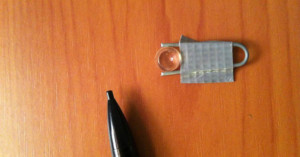
Last month we wrote about how the small focusing lens inside a laser pointer can be repurposed as a cheap macro lens for your smartphone. After seeing this project online, photo enthusiast John Coleman decided to give it a shot. To keep the lens secure against your phone, you’ll need something to hold it (e.g. a hair pin) and some tape to attach the holder to the phone. The photo above shows the super simple attachment Coleman created.
Read more…

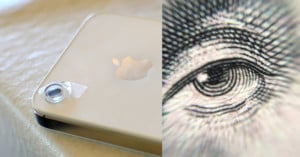
If you want to take Lensbaby-style selective focus macro shots using your phone, go buy a cheap laser pointer. Photographer Zaheer Mohiuddin writes that the lens inside laser pointers (the one that focuses the laser) works well as a macro lens for the tiny cameras found on smartphones. After taking the device apart and finding the small gem-like lens, simply attach it to your camera with some tape to start shooting close-up pictures.
Read more…

On a rainy day recently, light painting photographer Jeremy Jackson was playing around with a green laser pointer when he discovered something interesting: all the out of focus raindrops in the photograph had a lined pattern in them — and each one was unique! These “water drop snowflakes” were found in all of the photos he took that day.
Anyone know what causes this phenomenon?
(via DIYPhotography)
Image credit: Photograph by Jeremy Jackson and used with permission

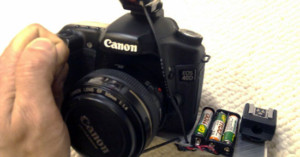
Photographer Adrian Onsen wanted to use the AI Servo autofocus mode on his Canon 40D in low-light situations, but found that the AF assist beam is only emitted once until focus is achieved rather than every time the camera needs to refocus. He then purchased a laser pointer from a dollar store, disassembled it to obtain a defocused beam of light, and attached it to the top of his camera. The hacked-together AF assist tool ended up working pretty well — Onsen was able to shoot sharper photos at a dance club without anyone noticing the extra light. To learn more check out his in-depth writeup here.
AF Assist tool (via Hack a Day)
How much does a camera vibrate due to your finger pressing the shutter or the mirror flipping? Camera Technica decided to conduct a test by strapping a laser pointer to the hot shoe of a Canon 7D. They then filmed the red dot on a far wall against some text while shooting normally (i.e. pressing the shutter with a finger), using a remote shutter release, and finally with a remote shutter as well as mirror-lockup.
You might be surprised at how much movement the camera experiences even if the shutter is pressed carefully. Lesson learned: for the sharpest possible photos, use a tripod, a remote shutter release, and the mirror-lockup feature on your camera.
DSLR Mirror Vibration (via Foto Actualidad)