Is a college photography degree worth it? It depends on who you ask. There are plenty of successful photographers out there who have never set foot inside a university photography lecture, while others have done just as well after earning that diploma. According to a recent study by Kiplinger, however, you might want to think twice before checking the “photography” box on your college app. After analyzing the salaries and jobless rates for grads of the 100 most popular majors, they found photography to be one of the 10 worst, and write,
Shutterbugs beware: The new-grad unemployment rate for film and photography majors is only narrowly better than the rate for high school dropouts. Film and photo students face tough competition in a crowded industry, and low starting salaries are the norm even in expensive industry hubs such as New York and Los Angeles. Interestingly, film and photography grads are still the best-paid of the art majors, though they make almost $10,000 less than the typical holder of a bachelor’s degree.
Some interesting figures: there’s a 7.3% unemployment rate for photo degree holders in general, and a 12.9% rate for recent graduates. The median salaries are $45,000 and $30,000, respectively.
Every year I meet with lots of students, assistants, young photographers, and photography educators and discuss the business of photography. Over the years I have complied a list of the biggest mistakes that most young photographers make when trying to become full-time money-making commercial photographers. I want to share those with you in the hope that people stop making the same mistakes. Read more…
Parisian photographer Malo has fun portrait series titled “Un jour, mon enfant tu seras” (One Day You Will Be My Child) that imagines what a baby’s future career might be. Read more…
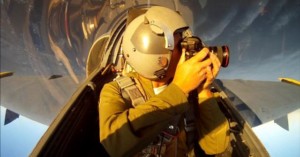
Aviation photographer Justin de Reuck has an awesome job: rather than do photo shoots in the comfort of a studio, he hops into fighter jets to photograph other airplanes in flight. This behind-the-scenes video shows him at work, snapping images while zipping around above the clouds and battling G-forces. The photographs that resulted from this shoot can be seen here.
When was the last time you came across a photography-related job opening this awesome? The United Nations Educational, Scientific and Cultural Organization (UNESCO) is looking for a “Senior Photographer” for its Paris station. It pays the equivalent of $100,000 a year tax free, and has great benefits (e.g. 30 days of vacation per year). Check out the opening here.
Photographer Laurence Kim wrote an interesting article titled “The Photography Business and the American Dream” in which he takes a look at the economics of doing photography as a career, coming to the conclusion that it’s one of the worst things you can do from a wealth creation standpoint.
I actually can’t think of a worse business than photography. I honestly can’t. In fact, if I were teaching an entrepreneurship class at a business school this would make a great exercise: Have my class think of a business that builds zero equity, had zero scalability and zero barriers to entry. It would be interesting to see if my class could come up with professional wedding/portrait photography. Knowing what makes a bad business would be very helpful in designing a good business.
The bottom line is this: from a wealth-creation standpoint, photography is a lousy career. But you probably already know that.
On the flip side, if you’re toiling as a photographer, you’re likely driven by a love of photography, not a love for money. Kim has some helpful tips for how to do photography as a career while staying smart financially.
Much like newscasters, photojournalists are expected to be on the front lines, with a job description that requires them to enter some of the most dangerous, remote or volatile places on earth. Many are on call 24 hours a day. And when news breaks, the photojournalists may have to mobilize with extremely short notice and stay on assignment for extended periods of time.
They also report that the average salary of a photojournalist in the US is $43,270.
Photographer Danny Cohen does things a little differently than most. Wanting to work for photographer David LaChapelle, Cohen eschewed all the boring old methods of self-promotion and opted to plaster a 43-foot sign on a bridge in Melbourne the night before LaChapelle was scheduled to shoot there. The banner read “ATTN: DAVID LACHAPELLE I WANT TO BE YOUR ASSISTANT .COM”.
Cohen received a call from LaChapelle within an hour of the renowned photographer seeing the banner.
Bruce Dale spent 30 years as a staff photographer for National Geographic, travelling the world and having thousands of his amazing photographs published in the magazine. In this 10 minute video, he talks about his experiences and shares stories behind some of his favorite photographs. Like the 1978 photo agency documentary we shared yesterday, this one also provides an interesting and inspiring behind-the-scenes look at a particular photography job.
Lady Gaga’s most recent music video for “Telephone”, featuring Beyonce, is like most modern music videos: rife with product placement. But among the most prominent products was Gaga’s own employer, Polaroid, which gets a 10-second spot.
You may recall the buzz during CES 2010 when Polaroid announced the music artist was hired as their creative director for a specialty line.
It’s good to know that some people are getting jobs these days.