The bean bag is a tool that photographers sometimes use to stabilize their camera. Plop it down on a fixed platform, and the bag can do wonders for achieving sharper shots. Instead of buying a bean bag for a marked up price, you can easily create a do-it-yourself version at home. After all, it’s just some beans in a bag… Digital Camera World has a step-by-step tutorial on how you can create one using some lentils and a pair of unwanted jeans.
What’s great about using a pair of jeans, beside the fact that denim is a very durable material, is that you can cut out the crotch section — a bit strange, we know — in order to give your bean bag a built-in zipper. This makes filling the bag a breeze, and allows you to quickly change the number of beans inside to make the bag softer or firmer.
Nokia faced the heat of the Internet yesterday after it came to light that a promo video for its new PureView image stabilization technology had been faked. The video, which was supposed to show off the company’s fancy-schmancy new floating lens technology, didn’t actually show real Lumia 920 footage, but rather footage captured using an actual stabilized camera. Nokia responded today in a blog post titled “An apology is due“:
In an effort to demonstrate the benefits of optical image stabilization (which eliminates blurry images and improves pictures shot in low light conditions), we produced a video that simulates what we will be able to deliver with OIS.
Of course, hindsight is 20/20, but we should have posted a disclaimer stating this was a representation of OIS only. This was not shot with a Lumia 920. At least, not yet. We apologize for the confusion we created.
It also published the video above, which is an actual side-by-side comparison video that it showed at the Lumia 920 press conference. While the stabilization is certainly noticeable, what we’d like to see most is the faked promo reshot using the Lumia 920. It’d be interesting to find out whether it’s even comparable to what we were briefly awe-struck by.
The company unveiled its new Lumia 920 phone today, which also carries the PureView name. It features a much more modest 8-megapixel camera, showing that PureView isn’t about the megapixels after all. Read more…
One of the interesting features in Olympus’ OM-D EM-5 retro-styled camera is the 5-axis image stabilization, which shifts the sensor in 5 different axis directions (existing systems generally use 2) to compensate for camera shake. It’s a feature that caught the eye of Vimeo user Fiatopichan, who suffers from essential tremor (a neurological disorder that causes his hands to shake at about 5-10 Hz). He decided to buy the camera to test out the new system, and reported his findings in the video above. The stabilization is quite impressive.
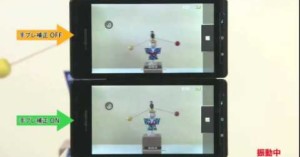
Sharp recently announced its AQUOS SH-01D phone, which is one of the few phones on the market that feature optical image stabilization. The phone is powered by Android OS, and features a 12.1 megapixel 1/3.2-inch CMOS sensor. The demo above shows how effective the stabilization is at canceling out small movements of the sensor.
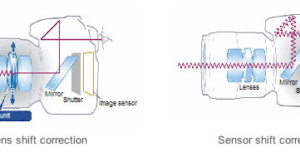
Nikon has a support page for people who wonder why the company hasn’t added sensor-shift image stabilization to its DSLRs. The first point is that stabilizing the image before it enters the camera allows the user to see exactly what the sensor “sees” through the viewfinder, and allows the autofocus and metering sensors to take advantage of this stabilized image as well. Secondly, they state that they can optimize the system for each lens to achieve finely tuned stabilization that gains extra stops of light over sensor-based systems.
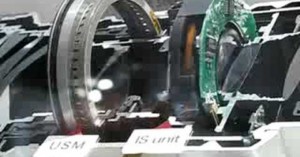
We shared a video of Canon’s Image Stabilization technology in action in the beginning of the year, but that was on a pro telephoto lens and inside a glass display case. What would the same technology look like in a cheaper, consumer lens? Preston over at Camera Technica decided to find out, disassembling a Canon 18-55mm kit lens to capture this short video of the IS mechanism in action. I had no idea the thing used springs, did you?
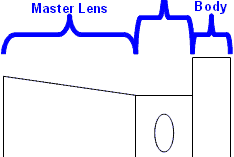
Canon might be rolling out a new Image Stabilized lens with a built-in teleconverter, but Tamron and Nikon seem to have image-stabilization/vibration-reduction tricks up their sleeve as well. Apparently in the early 2000s both Nikon and Tamron filed patents for teleconverters with image stabilization baked right in. Tamron’s was for a standard unit that sits between the lens and the camera body, while Nikon’s was for a unit that sits in front of the lens. Read more…