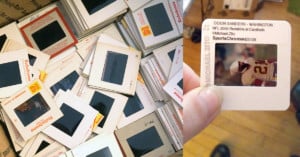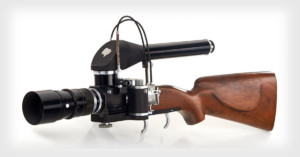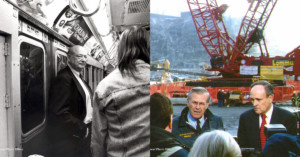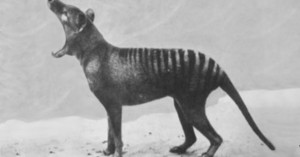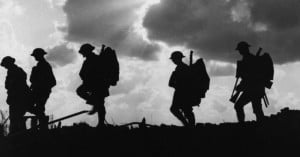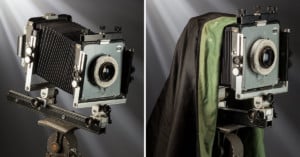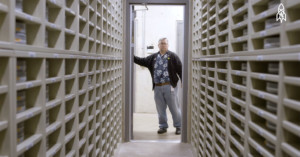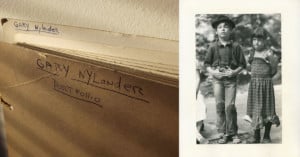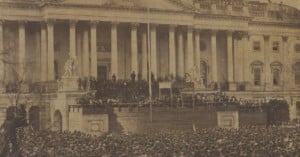
The New York Times has launched a new Tumblr site called “The Lively Morgue” to breathe new life into items in the newspaper’s photo archive (nicknamed “The Morgue”). Each week they’ll be sharing several historical photographs found in massive collection. Just how massive?
We don’t know. Our best guess is five million to six million prints and contact sheets (each sheet, of course, representing many discrete images) and 300,000 sacks of negatives, ranging in format size from 35 millimeter to 5 by 7 inches — at least 10 million frames in all. The picture archive also includes 13,500 DVDs, each storing about 4.7 gigabytes worth of imagery. When the Museum of Modern Art set out to exhibit the highlights of the Times archive in 1996, it dispatched four curators. They spent nine months poring over 3,000 subjects, working with two Times editors, one of whom spent a year on the project. In the end, they estimated that they’d seen only one-quarter of the total. [#]
To make the project even more interesting, they’re also publishing an image of the reverse side of each print. This often reveals information such as how often the image was used, notes by the photographer, and the original caption that was chosen.
Here’s your interesting photo fact of the day: did you know that sepia toning (when B&W photos are given that distinctive warm tone) is named after the Common Cuttlefish? The scientific name of the species is Sepia officinalis, and the ink produced by the cuttlefish was used for sepia toning when the technique first emerged in the 1880s.
Sepia is a dark brown-grey color, named after the rich brown pigment derived from the ink sac of the common cuttlefish Sepia. The word sepia is the Latinized form of the Greek σηπία, sēpía, cuttlefish. [#]
Nowadays, sepia ink is generally replaced with other dyes or pigments that produce the same hue.
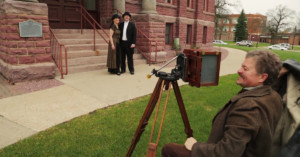
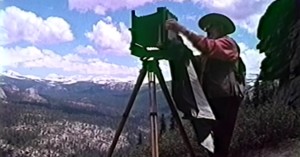
[...] an elegant, moving, and lyrical portrait of this quintessentially American photographer. The documentary weaves together archival footage, photographic images, dramatic readings of the artist’s own writing, and interviews with leading photographers, historians, curators, naturalists, as well as Adams’s family, friends, and colleagues, to tell the story of a man who was at once a visionary photographer, a pioneer in photographic technique, and an ardent crusader for the cause of environmentalism.
It’s about 80 minutes long. You can find out more about the film here.
Design director Wayne Ford has written up a great piece on the career of American photographer Arnold Newman, who was in the vanguard of the “environmental portrait” movement that emerged in the early 1940s.
By this point, [Alexey] Brodovitch — the indirect teacher — was very aware of the young photographers work and his growing reputation, and began assigning him regular portrait commissions for Harper’s Bazaar. One of these assignments was to photograph the Russian composer, Igor Stravinsky, which resulted in one of Newman’s most iconic images, although at the time it was rejected for publication. ‘Sometimes, as with his famous image of Stravinsky, he would have to recreate a natural habitat artificially,’ remarks Huxley-Parlour, ‘so he expressed his essence by placing him at a grand piano in an editor’s apartment,’ creating a strong, hard, linear composition, ‘very much like Stravinsky’s music.’
During his lifetime, MIT engineer and businessman Nick DeWolf founded the giant electronic testing company Teradyne and designed more than 300 semiconductor and electronic test systems. In his spare time he was also an avid photography enthusiast, carrying a camera with him at all times. After his death, his son-in-law Steve Lundeen began working to archive and share the enormous body of work. Lundeen is currently publishing the original sets of photographs to Flickr at a rate of 20-50 images per day, and has already uploaded a whopping 50,000 photographs. You can follow along and enjoy the time-travelling pre-digital stream of images by following the Nick DeWolf Photo Archive’s photostream.
Ever wonder how the US government managed to capture spy photos with satellites during the Cold War without the help of digital cameras, computers, or wireless transmission? The Atlantic has a fascinating article on the various techniques that were used:
From 1971 to 1986 a total of 20 satellites were launched, each containing 60 miles (100 kilometers) of film and sophisticated cameras that orbited the earth snapping vast, panoramic photographs of the Soviet Union, China and other potential foes. The film was shot back through the earth’s atmosphere in buckets that parachuted over the Pacific Ocean, where C-130 Air Force planes snagged them with grappling hooks.
This photo shows what 5MB of hard drive storage looked like in 1956. The IBM 305 RAMAC hard disk was state of the art, weighed just shy of a ton, required a forklift to be carried around, and was composed of 50 separate 24-inch discs that occupied 16 square feet. The annual cost of using it was a staggering $35,000 — steep even in today’s money. Nowadays most RAW photos outweigh the storage capabilities of that behemoth of an external hard drive…
Did you know that in vintage tintype photographs of infants mothers were often present in the photo but hidden by a veil? Subjects needed to remain still due to the longer exposure times required back then, so mothers were often asked to hold their children tightly while the portraits were being exposed. It was common practice back then, but the resulting photos are pretty eerie when you look at them now. Read more…
This might look like some kind of microscopic organism, but it’s actually a high-speed photograph of a nuclear explosion. It was captured less than 1 millisecond after the detonation using a rapatronic camera, which is capable of exposure times as brief as 10 nanoseconds (one nanosecond is one billionth of a second). The photograph was shot from roughly 7 miles away during the Tumbler-Snapper tests in Nevada (1952). The fireball is roughly 20 meters in diameter, and three times hotter than the surface of the sun.
The first known light painting photographs were made way back in 1914, when Frank and Lillian Moller Gilbreth used small lights and long exposure photos to capture the motion of workers. Subjects ranged from handkerchief folders to bricklayers. The photos weren’t meant as art, but were instead made to help develop ways to increase employee output and simplify job tasks. Read more…