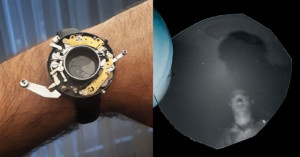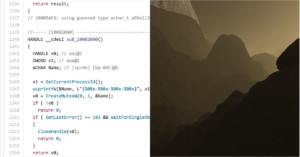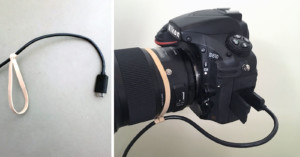
When Milan-based engineer and photographer Andrea Biffi needed a constant source of power for his Canon 40D in order to shoot time-lapse photos over many hours, he decided to save some money by going the DIY route. Biffi turned a defunct lithium DSLR battery into a power supply unit that can be used with everything from a wall outlet to a car battery.

You can do the same thing at home, but you’ll need a bit of engineering know-how to accomplish the hack.
Read more…

Last week, we wrote on how you can use LEGO pieces to keep your lens caps on your camera strap when they’re not protecting your lenses. A reader named Fearn quickly pointed us to a similar tip published over at Sugru at the end of last year. Instead of using camera straps, however, they suggest tripods as a sturdy way of keeping track of the caps.
Read more…

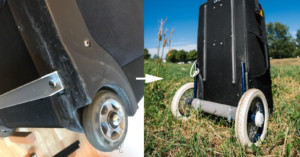
Focus stacking is when you combine multiple photographs of different focus distances in order to obtain a single photo with a much greater depth of field than any of the individual shots. This can be done by turning the zoom ring on your lens, but this can be difficult to control (especially for highly magnified photos). It can also be done using special rigs designed for the purpose, but those are generally quite pricey.

Photographer and software engineer David Hunt recently came up with the brilliant idea of turning an old flatbed scanner into a macro rail for shooting focus-stacking photos.

Read more…

After recently purchasing a Nikon 1 V1, Swedish photographer Sven Hedin decided to work on making the camera work with an external flash. Not just any external flash, mind you, but a vintage flash unit — the kind that uses disposable bulbs.
Read more…

For a fleeting, wonderful moment, it seemed that all of our Instagram popularity dreams were coming true. Released two days ago, the app Firegram used some automatic magic to get your photos way more attention than they would ever have gotten on their own. When Roi Carthy of TechCrunch tried it out on one of his photos he got a whopping 56 likes (%1500 increase) in no time.
Alas, if it seems too good to be true, that’s because it wasn’t meant to last. As of now the app has been “discovered” by Instagram and denied access to its API — no likes for you.
Read more…

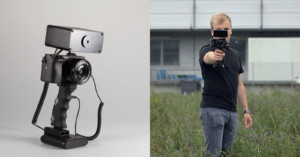
Lytro‘s groundbreaking consumer light-field camera made a splash in the camera industry this year by making it possible to refocus photographs after they’re shot. However, the cheapest model for the boxy device has a price tag of $399, and the reviews have been mixed so far.
If you’d like to play around with your own refocus-able photographs without having to buy an actual Lytro device, you can actually fake it using a standard DSLR camera (or any camera with manual focusing and a large-aperture lens).
Read more…

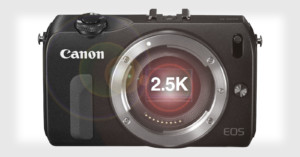
Back in October, Roger Cicala shared some first impressions of the Canon EOS M with us, and stated that he believes the camera is “a firmware update and a price drop away from being a great camera.” While we haven’t seen any major price cuts to the camera so far, a firmware update may be on the near horizon.
By “update,” we mean “third-party firmware enhancement.” Magic Lantern has announced that its firmware add-on will indeed work with Canon’s mirrorless camera, and that they’ve begun the process of porting it.
Read more…

Photographer Nick Cool came up with one of the strangest pieces of do-it-yourself camera gear that we’ve seen so far this year. He took an ordinary stainless steel sink filter — yup, the thing that catches food at the bottom of kitchen sinks — drilled various-sized holes through it, and stuck it into a filter ring after taking out the glass. The resulting photographic sink filter takes soft focus photos with pretty strange-looking bokeh in the background. Changing the size of the holes drilled into the plate produces different bokeh styles.
You can find the step-by-step tutorial on the build over on DIYPhotography. There are also some more sample photographs over in this Flickr set by Cool.
How To Build A Soft Focus Filter From A Sink Drainer [DIYPhotography]
Image credits: DIY soft focus filter and DIY soft focus filter by Nick Cool

Samsung released the open source kernel files for its new Galaxy Camera late last week, something commonly done in the smartphone world — at least with certain platforms — but a foreign concept in the world of digital photography. This opens the door to all kinds of possibilities as hackers begin to peer into the cameras brain and dream up new possibilities for how it should work.
Developers are already talking about the possibility of introducing voice calling to the camera — a feature Samsung left out of the camera, presumably to avoid cannibalizing its smartphones.
Read more…

Here’s a clever trick for if you ever need to print out a photo but find your inkjet cartridges low (or dried out): bust out your hair dryer. Paul Boutin of The New York Times writes,
If your printer’s ink cartridge runs dry near the end of an important print job, remove the cartridge and run a hair dryer on it for two to three minutes. Then place the cartridge back into the printer and try again while it is still warm.
“The heat from the hair dryer heats the thick ink, and helps it to flow through the tiny nozzles in the cartridge,” says Alex Cox, a software engineer in Seattle. “When the cartridge is almost dead, those nozzles are often nearly clogged with dried ink, so helping the ink to flow will let more ink out of the nozzles.” The hair dryer trick can squeeze a few more pages out of a cartridge after the printer declares it is empty.
The trick only works once or twice per cartridge, but apparently it works pretty well.
(via Lifehacker)