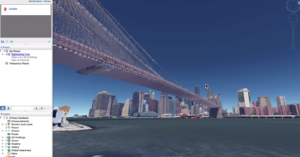
Ever wonder how Google manages to capture street-level photographs of entire cities for its Street View? It’s done using a giant fleet of camera-equipped cars. Google employee Masrur Odinaev recently shared this photograph — taken by a Street View car — showing one of Google’s Street View car parking lots. We see a large fleet of Subaru Imprezas that have panoramic cameras mounted to the tops. Read more…
When tourists visit famous landmarks, they commonly pull out their own cameras to snap some photographs as mementos, even if they themselves aren’t in the picture. Despite the fact that there’s almost always guaranteed to be an identical photograph taken by someone else, somewhere online, there’s something about capturing the moment for oneself that makes redundant photos special.
That’s why a new patent filed by Google is a bit puzzling. It’s called “Image zooming using pre-existing imaging information” and, as the title suggests, revolves around using other people’s photographs to “boost” a digital camera’s zoom. Read more…
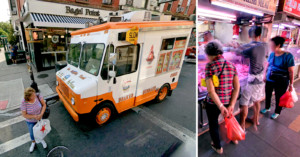
Google’s Street View imagery features plenty of photographs of people, but they’re often distorted and almost always feature blurred faces. Street Ghosts is a project by artist Paolo Cirio that reintroduces these distinctive portraits back into the real world. After choosing a particular photo containing a person in Street View, Cirio prints it out as a life-sized print on thin paper, cuts out the person, and then uses wheat-paste to affix the giant person photo onto the exact location where the photo appeared in the virtual world. Read more…
When news of Google’s acquisition of Nik Software emerged a week ago, most of the tech press (and this blog) focused on one particular offering: Snapseed. It’s a highly-acclaimed mobile photo editing app that has been growing like a weed as of late, so it made sense that Google would want it to participate in the ongoing mobile photo sharing war, right? Well, maybe not. Read more…
Nik Software announced today that it has been acquired by Google. The company is the maker of Snapseed, one of the most popular photo editing apps in the iTunes App Store and a competitor to Instagram. Read more…
If Google’s vision of the future of photography comes to pass, we’ll soon find ourselves in a world in which camera glasses are worn around as an everyday fashion accessory. Perhaps in an effort to make this idea easier to stomach, Google partnered up with luxury fashion company Diane von Fürstenberg (DVF) today for the label’s Spring 2013 fashion show, equipping people on and around the runway with its high-tech glasses. Glass wearers included runway models, Google founder Sergey Brin, and designer Diane von Furstenberg herself. Read more…
On of the neat things about working at Google is the fact that the company loves letting its employees hear from the world’s best minds through the AtGoogleTalks. Through the series of lectures, Google invites well-known individuals to share on their area of expertise for 40-70 minutes. In addition to the thousands of politicians, musicians, and entertainers who have shared so far, there have also been a number of photographers invited for Photographers@Google presentations.
The video above shows a lecture given by HDR landscape photographer Trey Ratcliff last year. Read more…
Back in May, we wrote about a photographer named John Butterill and his brilliant idea of using a Internet-connected phone to share his photo adventures with people whose mobility was limited. Google liked Butterill’s story so much that they’re sharing it as an example of the different things you can do through Google+ Hangouts. The video above is a neat look at how Butterill came up with his idea, and how the concept quickly spread around the world. Read more…
The deadline to put up initial bids for Kodak’s 1,100 patent sale is Monday, and The Wall Street Journal reports that the two biggest contenders, Apple and Google, are forming “coalitions” with other companies in preparation for the all out patent brawl. The last time this happened, an Apple/Microsoft alliance ended up winning the battle against Google, that time over a patent sale by Nortel Networks. Read more…
Professor and self-proclaimed cyborg Steve Mann created an eye and memory-aid device he calls the EyeTap Digital Glass. The EyeTap, worn by Mann above on the left, is a wearable device that is similar to Google Eye, pictured right, but he’s been making them at home since the 1980s. The goal of his project is to use images to aid memory, or even to augment the memories of people with Alzheimer’s Disease or who simply want to preserve their memories more permanently. However, a recent misunderstanding over Mann’s technology allegedly caused a confrontation between Mann and several employees at a Paris McDonald’s restaurant. Read more…