Here’s a strange (and extremely rare) piece of camera gear: the Leica Telephoto Assembly Rifle. Also known as “the Leica Gun”, it was made for photographers at the 1936 Olympics in Berlin, Germany, and became popular among wildlife and sports photographers during the interwar years. One of them will be auctioned off at the Tamarkin Rare Camera Auction on October 30th, and is expected to fetch up to $100,000.
Who knows, maybe shoulder stocks will make a comeback as a form of image stabilization.
Videographer Joel Loukus created a continuous ring light source — which he calls the “WreathLight” — using a wreath frame and two strings of Christmas lights. The total cost came out to $24. It’s a cheap and easy way of adding some soft lighting to your portraits. Read more…
According to Nikon Rumors, Nikon has introduced a new Unilateral Pricing Policy on DSLR gear sold in the US that will take effect on October 16th. Saying that the policy is “designed to allow customers to make purchasing decisions based on service provided and not have to worry about hunting for a better price”, Nikon plans to withhold sales to any store caught pricing equipment below “national prices” that the company will set for each product. Read more…
If you have a GoPro or any other compact camera with a constantly exposed lens, you can protect the lens from scratches when it’s not in use by making a cheap DIY lens cap out of a ping pong ball and a rubber band.
Some photographers prefer using ordinary bags with padded inserts to carry their camera gear, both for aesthetic reason and to prevent theft. Instead of buying an insert, you can also make a custom one with some foam, fabric, and velcro. Abi over at vanilla & lace made one to turn her purse into a camera bag after finding that purse-style camera bags can cost up to $300. She also wrote up a helpful tutorial on how you can do the same.
Want a DSLR viewfinder but don’t want to pay big bucks for a professional one? Photojojo has a tutorial on how you can build your own DIY version using a lens from a pair of magnifying reading glasses and some plastic/foam board. It’ll definitely draw some weird looks but hey, it works!
Since we wrote about CineSkates last week, the tripod-on-wheels project has already raised nearly $200,000 in preorders — not bad considering the goal was only $20,000. Today, Emm over at CheesyCam just announced something similar: the Pico Dolly. It’s a tiny portable dolly system for your video-capable camera that lets you capture smooth tracking shots without the hassle of big and expensive equipment. Unlike CineSkates, they’re already shipping — $65 will buy you the dolly itself, and $90 gets you the dolly and an 11-inch friction arm.
Lost in the commotion of Sony’s awesome camera announcements was the official unveiling of the LA-EA2 A-mount adapter, which we reported on a couple weeks ago. This fancy lens adapter lets you use Sony’s Alpha line of DSLR lenses with NEX mirrorless bodies without the loss of autofocus functionality by having a translucent mirror and autofocus system baked into the adapter itself!
Adding a large lens and electronic viewfinder to a NEX body leaves you with one strange looking camera, but the ability to use your existing lens collection on a new mirrorless camera is definitely a big deal (hopefully Canon and Nikon offer something similar if they announce mirrorless cameras soon). The LA-EA2 will cost $400 when it arrives in November.

CineSkates are new patent-pending wheels that attach to JOBY’s GorillaPod Focus tripod, allowing you to capture fluid, stabilized video with your DSLR without bulky or expensive equipment. Read more…
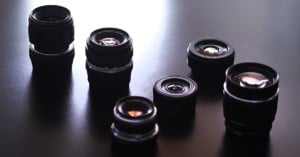
Rather than being built from scratch with new designs, new camera lenses are designed by taking existing lens designs that work well and then improving on them. As a result, virtually every lens design can be traced back to one of six basic lens designs developed in the early 1900s (shown above). Roger Cicala of LensRentals writes,
Those original lenses in their pure form each had strengths and weaknesses. Modern lenses derived from them have ‘inherited’ those same underlying tendencies. Many of the complex technologies used in a modern lens are put there to correct the underlying problems of the original design.
Head on over to his post to learn about lenses derived from the first three of these designs.