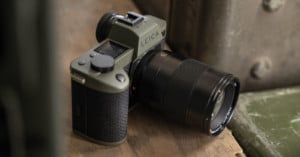
The 14 frame per second continuous shooting speed of the Canon 1D X DSLR probably isn’t a feature you’d associate with studio-lit portraiture, but that’s exactly what Australian fashion photographer Georges Antoni demonstrates in the short clip above. Using the Broncolor Scoro for stobe lighting, Antoni unleashes the full FPS potential of the camera in order to capture a model dancing in as many still frames as possible. Read more…
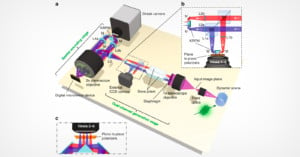
German scientists have been awarded a Guinness World Record for “fastest movie” after successfully capturing two images of an X-ray laser beam 50 femtoseconds apart. One femtosecond is equal to one quadrillionth (or one millionth of one billionth) of a second. Here’s some science talk explaining it:
[...] the scientists split the X-ray laser beam into two flashes and sent one of them via a detour of only 0.015 millimetres, making it arrive 50 femtoseconds later than the first one. Since no detector can be read out so fast, the scientists stored both images as superimposed holograms, allowing the subsequent reconstruction of the single images.
With these experiments, the scientists showed that this record slow motion is achievable. However, they did not only take the world’s fastest but probably also the shortest film – with just two images. Thus, additional development work is necessary for the use of this method in practice. [#]
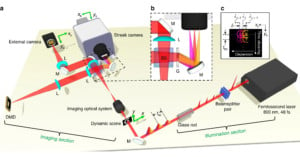
Here’s an interesting look at the amazing camera being developed at MIT that shoots a staggering one trillion frames per second — fast enough to create footage of light traveling:
[...] the researchers were able to create slow-motion movies, showing what appears to be a bullet of light that moves from one end of the bottle to the other [...] Each horizontal line is exposed for just 1.71 picoseconds, or trillionths of a second, Dr. Raskar said — enough time for the laser beam to travel less than half a millimeter through the fluid inside the bottle.
To create a movie of the event, the researchers record about 500 frames in just under a nanosecond, or a billionth of a second. Because each individual movie has a very narrow field of view, they repeat the process a number of times, scanning it vertically to build a complete scene that shows the beam moving from one end of the bottle, bouncing off the cap and then scattering back through the fluid. If a bullet were tracked in the same fashion moving through the same fluid, the resulting movie would last three years. [#]
They believe that the technology may one day be useful for medicine, industry, science, or even consumer photography.
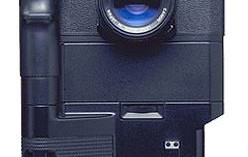
Canon’s new 1D X DSLR shoots at a whopping 14 frames per second, but did you know that it’s not the first Canon SLR capable of that frame rate? Nearly 30 years ago, back in 1984, Canon unveiled the “F-1 High Speed Motor Drive Camera”: a camera powered by huge battery packs that could chew through a roll of film in 2.57 seconds.
Canon’s new 1D X can shoot full frame 18-megapixel JPEGs at a whopping 14 frames per second with mirror-lockup. Drop down to 12fps, and you can shoot RAW images while continuously tracking the subject using AI Servo mode. Here are a couple videos that give you a feel for what 14fps on the 1D X is like. Read more…
Here’s a neat video that made its rounds on the Interwebs back in 2007, but maybe some of you haven’t seen before. To capture Barry Bonds setting the all time home run record, USA Today shot with three Canon EOS-1D Mark III at the same time, triggering the cameras in sequence so their 10 frames per second effectively became 30 frames per second. You can check out the frames captured of the home run slam here.
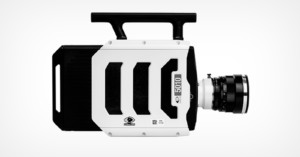
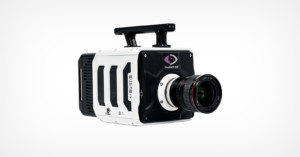
Google just released the latest beta version of its Chrome browser, and created a pretty amazing video to demonstrate how fast pages load. Using a Phantom v640 high speed camera, they film the browser racing random Rube Goldberg-style contraptions at up to 2700 frames per second. For example, in one test Chrome races a potato gun. Sweet.
They also have a cool behind-the-scenes video showing how the tests were done. I can’t believe it took 51 takes to get the potato gun shot to come out right.
Google puts out some of the most creative ads I’ve seen. Check out this one for Google Translate, or this one for Chrome Extensions.
One thing I love about photography and videography is that it often allows us to see things in different ways, whether it’s macro photography or slow motion video. The above video is absolutely stunning and will probably blow your mind. It shows an experiment in which a water drop is filmed at 2000 frames per second, revealing something you probably never knew about the behavior of water.