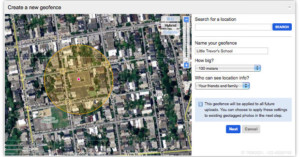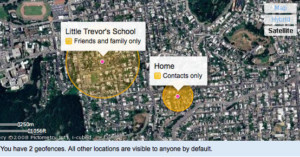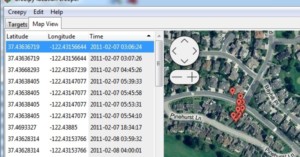
Flickr introduced an innovative location-based privacy feature today called “geofences“. It’s a way of assigning default privacy settings to certain locations for geotagged photographs. For example, you can assign a geofence with a certain radius around your home, and automatically set those photos’ location data to only be visible to your friends and family. Each user can have up to 10 geofences, and existing photographs are automatically updated to new geofence privacy settings.

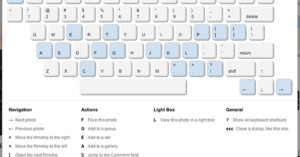
Here’s a nifty visual guide to all the keyboard shortcuts you have access to when viewing a photograph on Flickr. Don’t bother bookmarking this page though — Flickr just added these guides to every page on the site. Simply press the “?” key for the popup to appear!
(via Flickr Blog via Pixel Analogo)

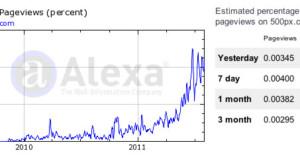
Alexa’s traffic reports seem to show that photo sharing service 500px is growing like a weed. The site has received quite a bit of coverage as of late.
Read more…

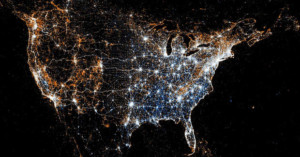
Last year map geek Eric Fischer created heat maps showing where Flickr photos are taken in large cities and comparing tourist vs. local hotspots. Now he’s back again with beautiful maps showing geotagged Flickr photos and Twitter Tweets, and the maps aren’t limited to cities — there’s maps for continents (see North America above) and even the whole world! The orange dots show photos, the blue ones indicate Tweets, and a white one means both were found in that location.
Read more…

Mashable is reporting that Google will be rebranding Picasa as “Google Photos” within the next six weeks, coinciding with the public launch of its Google+ social networking service. Blogger will also be rebranded as “Google Blogs”. Furthermore, images up to 2048x2048px won’t be counted towards the 1GB of free storage offered by the service for Google+ users, up from the 800px rule announced earlier this year. Larger images uploaded after the storage limit is reached will be automatically resized to 2048px, meaning Google is offering virtually unlimited storage for sharing photos online.

As Google continues to improve the photo sharing experience it offers, Flickr’s going to have to innovate quickly to prevent a mass exodus of photographers looking for greener pastures.
(via Mashable)
OpenPhoto is a new “open” alternative to Flickr being built by programmer Jaisen Mathai — an engineer who quit his job at Yahoo (Flickr’s owner) back in May 2011. Instead of storing images using company servers, this new service will allow users to connect their own online storage accounts to store their data within arms reach. This would be like using Flickr to share your images while having the photos themselves be stored in a location that you control (e.g. Amazon S3, Dropbox, etc…).
Mathai is planning to have an open source version of the software that anyone can install on their own servers, and also a hosted version of the software, much like WordPress.org and WordPress.com for blogging. He’s currently raising money for the project through Kickstarter, and plans to launch the hosted version of the service by September.
OpenPhoto (via TechCrunch)

Flickr is a popular method of sharing photos, but the service doesn’t provide any easy way to download them in bulk. Flick and Share is a web app that creates simple download links for Flickr sets that you can send to family and friends, allowing them to quickly download a copy of the images you shot at an event. We’ve tested it out, and it works as advertised.
Flick and Share (via Lifehacker)

One of the big complaints users (or ex-users) have against Flickr is that its account deletion process is often unexpected and almost always permanent. Many users — even paid subscribers — have found their accounts deleted and have had no way of appealing and no chance of recovering their data. Flickr finally addressed the issue today by changing its deletion policy — data is now stored for 90 days on the server after accounts are deleted, giving users a chance to appeal. Huzzah!
Your photos and data on Flickr [Flickr Blog]
Image credit: delete by Vitor Sá – Virgu

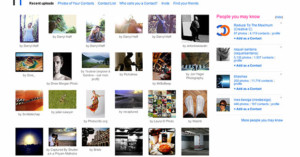
There have been a number of stories lately reporting that a large number of Flickr users are leaving the site for new photo-sharing services that are cropping up, including Instagram and 500px. Earlier his week, a designer at Flickr named Timoni West wrote a post on her blog that publicly criticized Flickr’s usability. More specifically, she calls the “Your contacts” page (the one that shows your contacts’ photos) the “most important page on Flickr”, pointing out the problems with the page and offering redesign ideas that would address them.
Read more…

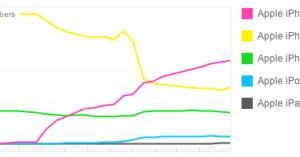
When the iPad 2 was announced a couple months ago, it was called “the first ‘camera’ to have a sensor resolution lower than the display resolution.” Commenters were quick to point out that Apple never intended for the device to be used as a camera like the iPhone is, and therefore was probably able to keep costs down by limiting it to a 0.7 megapixel sensor. Now, with millions of the devices in consumers’ hands, Flickr’s camera statistics confirm what we suspected all along: no one uses the iPad 2 as a camera.
Read more…