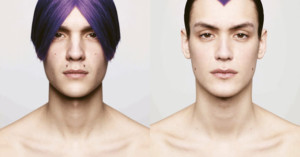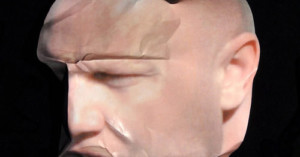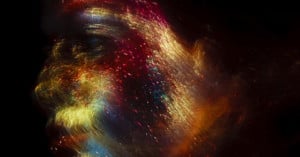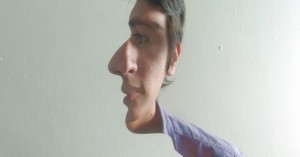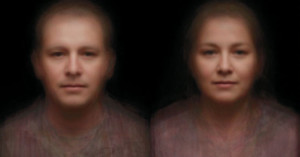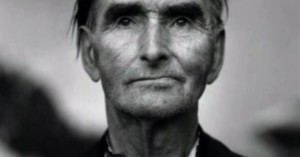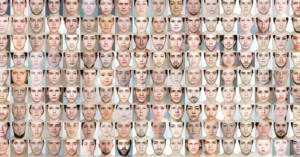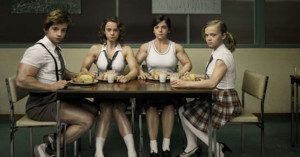
Symmetrical Portraits is a well-known and oft-imitated series of photos by photographer Julian Wolkenstein, shot back in 2010. After picking a number of subjects based on their facial features, he photographed them staring blankly straight-on into the camera. He then split the faces down the middle in order to obtain two separate “portraits” showing what the subject would look like if they had a perfectly symmetrical face.
Read more…

Earlier this month, Noah Kalina released an updated version of his everyday self-portrait time-lapse video, showing how his face changed over more than a decade. The video spans 12 years and 5 months, containing over 4,500 daily photos of Kalina’s face shot from the same angle and perspective.
Than Tibbetts wanted to see what the entire project would look like as a single frame, so he used FFmpeg to extract the frames from the video and ImageMagick to average them. The resulting image, seen above, shows how consistent Kalina was with his self-portraits over the years.
Average Noah Kalina [Thanland via kottke.org]
P.S. Last year, designer Tiemen Rapati did the same thing with 500 of clickflashwhirr’s daily self-portraits. That one turned out even better than this one.

Moscow-based photographer Alexander Khokhlov has a striking series of portraits of models with various designs painted onto their faces. The faces are either painted completely black or completely white, and then used as a canvas for some kind of artwork (e.g. a Mickey mouse face, a silhouette, a keyhole). Khokhlov calls the series Weird Beauty.
Read more…

The man in the moon and the face on mars. These are both the result of a psychological phenomenon known as pareidolia, which involves the brain trying to perceive random signals as significant. It’s one of the brain’s face detection mechanisms, and causes us to see faces where they don’t actually exist — the Virgin Mary’s face on toast, for example.
Programmer Phil McCarthy decided to play around with the idea of paredoila in artificial intelligence, and created a program called pareidoloop. It uses face detection algorithms to “see” human faces in randomly generated polygons.
Read more…

Fish Heads is a strange series of portraits by Los Angeles-based photographer Tim Tadder featuring subjects plunging their faces under the surface of water with wild expressions on their faces. The final photos are rotating, giving viewers a disorienting perspective.
Read more…

Diving is one of the most popular Olympic sports among spectators, and arguably one of the most graceful. The faces of the divers as they perform their acrobatics? Not so graceful.
ShortList Magazine took Getty photographs of divers and then cropped out their distorted faces. G-forces have quite a negative effect on beauty…
Read more…

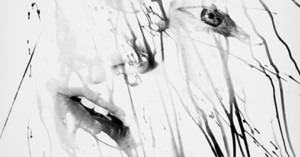
For his surreal series titled “Beibeees”, artist Alberto Seveso blended photos of women with smoke-like photographs of ink in water. To recreate this kind of look, try shooting smoke or ink against a pure white background and then use the cloudy formations as a layer mask on a portrait.
Read more…

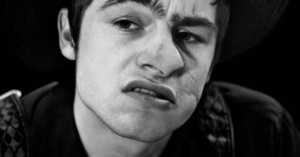
“Bodybuilders’ World” is a curious project by Belgian photographer Kurt Stallaert featuring digitally altered photos that combine the muscular bodies of bodybuilders with the youthful faces of children. At first glance they might look like ordinary portraits, but look a little closer and you’ll see that things look very wrong.
Read more…
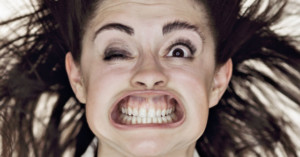
Last month a series of humorous photographs by Tadao Cern showing faces being blasted by air went viral on the web. Now, Cern is back again with slow motion footage captured during the photo shoots, and the clips are every bit as wacky as the still photos.

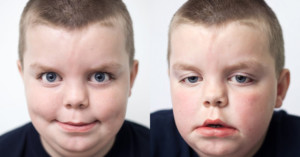
Being Brave is a series of portraits by photographer Andy Brown showing children before and after tooth extraction surgery. Brown first photographed each child bright-eyed and smiling in the waiting room, and then captured their faces again as they were waking up from general anesthesia.
Read more…