Pentax had a big announcement day today, unleashing three new cameras on the world of photography. The K-50 and K-500 are new mid- and entry-level DSLRs (respectively), and the Q7 is a new mirrorless camera that carries on the pint-sized tradition started by the Pentax Q back in 2011.
Read more…

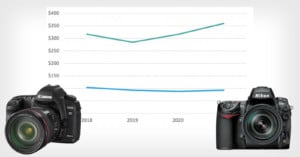
New cameras are like new computers. Both of them depreciate quite quickly as new technologies and new models are churned out year after year. This presents a perpetual problem for photographers, as many constantly grapple with the question of whether to upgrade their camera to a more recent model, or whether to purchase a higher-end model so that it keeps its value longer.
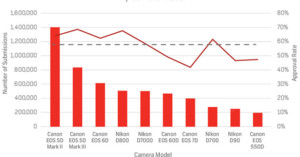
Market research software company Terapeak recently did a study that looks at depreciation in Canon EOS DSLRs. The results are pretty interesting.
Read more…

In the latest issue of Japanese magazine Impress, there’s a two-page section that predicts the new DSLRs that Canon and Nikon will be unleashing in this upcoming year. Alongside each model name, design illustration, and spec list is a percentage that indicates the likelihood of the rumor coming true.
Read more…
-
Martin Legeer · Dec 19, 2012
-

Back in March, a client for whom I’ve done some light consulting work asked me if it was possible to capture a 360-degree-image that can be rotated afterwards. I said of course, but didn’t think that much about the consequences — it’s a project that would wake me up at nights for the next few months.
Read more…

What does Nikon have up its sleeve for 2013? According to Nikon Rumors, it may be at least one pro-sumer DSLR early in the year, possibly followed by a beastly high-megapixel flagship DSLR later in the fall.
Read more…

As we’re exiting one camera announcement season, rumors are starting to heat up about the next. Canon reportedly has some major announcements just around the corner to announce three new cameras: a second mirrorless camera and two DSLRs.
Read more…

Mobile operating systems have begun making their way into digital cameras, but so far their foray has been limited to compact and mirrorless cameras. However, DSLRs are starting to have built-in Wi-Fi, but it seems to be only a matter of time before a full-fledged mobile OS appears in one.
Apparently some photographers (and Photoshoppers) over in China can’t wait for that day to arrive. There’s a series of viral images floating around showing Canon and Nikon DSLRs running various operating systems and programs.
Read more…

Earlier this month we shared some neat photos of astronauts using DSLRs while on spacewalks outside the International Space Station. In case you’re also wondering how the cameras are used inside the habitable satellite, we’ve carefully perused NASA’s 2Explore Flickr photo stream in search of those photos as well, and have collected them here in one place for your viewing pleasure. They’ve got some pretty nice gear up in the ISS… lucky astronauts.
Read more…

This photograph of Japanese astronaut Aki Hoshide taking a self-portrait was published to NASA’s amazing 2Explore Flickr account on Wednesday. It was snapped during a six-and-a-half hour spacewalk outside the International Space Station. The EXIF data embedded in the photo reveals that he was using a Nikon D2Xs with a 10.5mm fisheye lens at f/11, 1/500, and ISO 200.


Read more…

German photographer Falk Lumo has an interesting post on his blog regarding full frame and crop sensors. His theory is that camera manufacturers have created an artificial barrier between the two sensor sizes for business reasons, and that we’ll soon be seeing big changes in the camera world as this barrier disappears:
[...] there is an artificial separation between the APS-C and full frame markets. Artificial because less people still believe that full frame must be expensive. And artificial because image qualities beyond an effective resolution of 20 MP may simply require full frame. The new offers from Nikon (D800 and D600) therefore directly address this and may accelerate the disappearance of the artificial market separation. This is known as “supercriticality”: the market ought to offer uncrippled, full frame enthusiast cameras in the $1,500 segment but offers APS-C cameras instead. Supercritical systems “fall” into their preferred state after only small perturbations occur. Once this happens, a D800 type camera will be in the $1,500 segment.
He predicts that full frame cameras will soon be much more affordable and compact as mirrorless cameras eat into the APS-C market, leaving “cameras with a full frame mount but a half frame sensor” to be “a curiosity of the past.”
The full frame mystery revisited [Falk Lumo]