There’s a huge wave of anti-Japanese sentiment sweeping across China, with violent protests popping up all over the country in response to the ongoing dispute over islands in the East China Sea. Amidst the public anger, Japanese brands are taking a hit… literally. Read more…
Swedish YouTube user AnteboyanRox received an interesting surprise after purchasing a brand new HP laptop recently. After finding the operating system already configured, he/she discovered the above video sitting inside the “My Documents” folder. Apparently an assembly line worker at a factory in China was testing the laptop’s camera and then forgot to wipe it afterward. Chinese manufacturing companies are generally quite secretive, so candid videos like this one aren’t easy to come by. Last year something similar happened to camera megastore B&H.
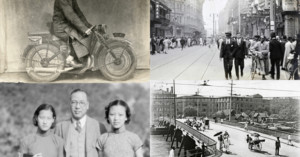
It’s nearly impossible to find a photograph in China taken before 1970 — most images were destroyed or removed to other countries during Mao Zedong’s Cultural Revolution.
A professor at Bristol University in the UK is running a project in search of these lost images, the BBC reports:
Such photographs are exceptionally rare in China. The turbulent history of the 20th Century meant that many archives were destroyed by war, invasion and revolution. Mao Zedong’s government regarded the past as a “black” time, to be erased in favour of the New China. The Cultural Revolution of the late 1960s finished the job.
“If you were at all savvy,” says (Professor Robert) Bickers, “you realised early on that you had to destroy your own private family records, before the Red Guards came and found evidence of your bourgeois, counter-revolutionary past, when you might have drunk coffee in a café bar, à la mode.”
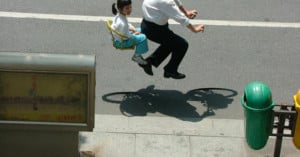
Floating is a series of manipulated photographs by Chinese photographer Zhao Huasen showing people in China riding around on invisible bicycles. Read more…
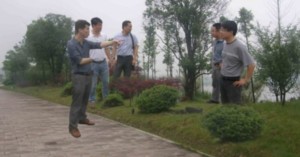
Chinese government officials never seem to learn. If you’ve been following us for a while, you may remember the Chinese government’s Photoshop fail from last year, where three officials were supposedly inspecting a road, but instead looked more like they were floating above it. And on May 9th five more government inspectors were immortalized floating around, this time inspecting a park. Read more…
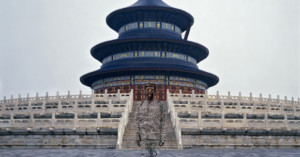
After his Beijing studio was destroyed in 2005, artist Liu Bolin (AKA “The Invisible Man”) began a project titled “Hiding in the City” that show him blending into various locations around Beijing. The photographs aren’t Photoshopped — Bolin carefully has his body painted to blend in with each landscape. TIME writes,
Each image requires meticulous planning and execution: as both artist and performer, Bolin directs the photographer on how to compose each scene before entering the frame. Once situated, he puts on his Chinese military uniform, which he wears for all of his Invisible Man photographs, and, with the help of an assistant and painter, is painted seamlessly into the scene. This process can sometimes take up to ten hours with Bolin having to stand perfectly still. Although the end result of Bolin’s process is the photograph, the tension between his body and the landscape is itself a manifestation of China’s incredible social and physical change. [#]
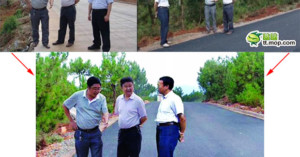
Earlier this week an Internet user in China visited their county government website and was greeted with a horribly Photoshopped photograph showing three government officials inspecting a road. The caption read,
County mayor Li Ningyi and vice-mayor Tang Xiaobing are inspecting the newly constructed country road at Lihong Town.
When governments or corporations do a bad job at image manipulation and get caught, the photos often go viral get remixed all over the Internet — see BP’s helicopter incident — and this case was no exception. The photo immediately spread across forums, and Photoshop users began creating image showing the three officials in all kinds of random situations. Read more…
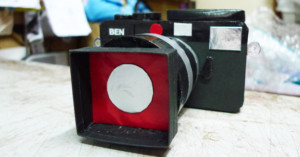
In China there’s a belief that burning paper representations of a deceased person’s belongings allows it to be transfered to the afterlife for the departed person to use. Au Yeung Ping Chi, an effigy maker in Hong Kong and the owner of Bo Wah Effigies, is often asked to create effigies of trendy consumer items such as iPhones and Nintendo Wiis for relatives of those who die young. The above is a camera he created for the purpose of afterlife photography. He’ll probably be asked to create Leica M9 Titanium editions soon.
Check out some more of Au Yeung’s paper creations here.
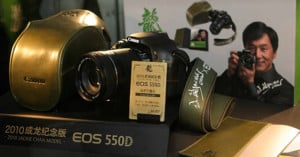
The “EOS 550D Jackie Chan Eye of Dragon” special edition kit comes with an EF-S 18-135mm lens, camera case, strap, and special photo album. Everything except the lens is branded with Jackie’s logo. Only 2010 of these kits will be made, and each costs a whopping ¥10,000, or roughly $1465.
Any guesses as to which random celebrity Nikon is planning to team up with?