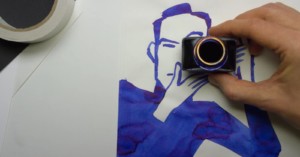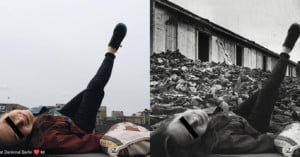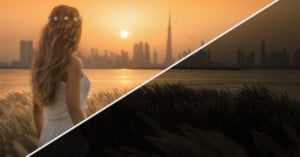
Here’s a tutorial by Elizabeth Giorgi of Being Geek Chic on how you can turn your Instagram photos into beautiful canvas-style prints for about a buck a pop. You can find a text version of the tutorial here.
Brazilian artist André Feliciano creates beautiful gardens that look rather ordinary from afar, but step a little closer and you’ll notice that each individual flower is quite peculiar: it’s shaped like a camera. Feliciano’s colorful displays feature hundreds or thousands of tiny plastic cameras. Read more…
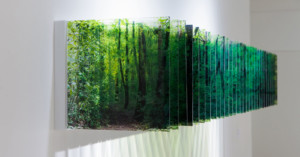
Artist Rodrigo Torres creates amazing 3D topographic sculptures of landscapes using a stack of 2D prints. This idea would be amazing for cityscape sculptures.
The Portrait Project is a series of 10 stitched portraits by London-based artist Evelin Kasikov. Each portrait is created with an actual Polaroid picture as the starting point, and is based on the same grid. The idea is similar to pointillism, but instead of dots she uses squares, crosses, and lines of different colors and weights. 10-15 feet of cotton thread does into each piece, and stitching them takes between two days and a week to complete. Read more…
Don’t mess with Marc Jacobs. That’s the lesson graffiti artists should take from a teensy little altercation between Marc Jacobs and the infamous graffiti artist Kidult. When Marc Jacobs employees awoke to a vandalized Soho boutique the morning after the Met Ball, they snapped a few photos before starting to clean it up. But instead of just stopping there and moving on, Marc Jacobs decided instead to turn the whole thing on its head, slap the photo on a t-shirt, and sell it with the caption “Art by Art Jacobs.” Read more…
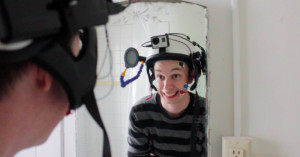
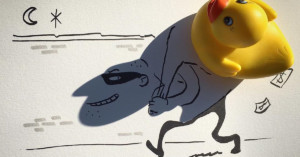
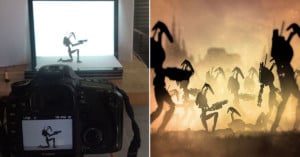
Tim Noble and Sue Webster are a London-based artist duo that creates amazing shadow art installations using carefully arranged objects. They use everything from trash to metal cans shot with BB pellets, arranged to cast shadows of people and skylines on the wall when a light is shined from a certain direction. Read more…
Artist Alan Belcher is known for pioneering a genre of art known as “photo-object” in which the disciplines of photography and sculpture are fused and explored in different ways. His latest piece is titled “_____.jpg”, and consists of 125 ceramic sculptures of the ubiquitous Apple JPG icon. Each one was manufactured in China and then signed, numbered, and dated. They’re currently on display at the Marianne Boesky Gallery in Manhattan. You can see a close-up view of the tile here.
Artist Maarten Baas has a project called “Real Time” in which he creates one-of-a-kind clocks using a video camera and boatloads of patience and dedication. He creates 12-hour-long loops of people manually setting the time on various clocks… in real time. The video above shows his grandfather clock exhibit in which the hour and minute hands of the clock are painstakingly drawn in every minute of every hour for twelve hours. Read more…
The portrait serves a testament to the subjects’ prosperity and personal relations, and yet, despite the time and care people take when having their pictures taken at commercial studios, the resulting photographs are rarely considered aesthetic objects. They are documentation. Herting’s work questions what, exactly, we are documenting in this benign, constructed way.
The studio-portrait experience has a structured set of parameters that form a stylistic equation. When participating in this process we become blind to its constructs. Artists disrupt and violate codes and, in doing so, bring them to our attention. Herting breaks the rules of the studio portrait, and the resulting photographs no longer fulfill their role as social symbols. Images programmed to be evidence of happiness or prosperity become painful, ugly or embarrasing, possibly revealing something unseen before.
If you can wrap your mind around this, please leave a comment with your translation or interpretation.
“The Collective Snapshot” is a series by Spanish photographer Pep Ventosa (previously featured here) that consists of abstract images of famous landmarks created by blending together dozens of ordinary snapshots. His goal is to “create an abstraction of the places we’ve been an the things we’ve seen”, and to create images that are both familiar and foreign at the same time. Read more…