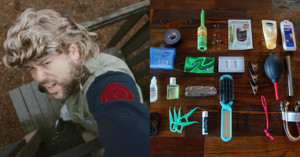
Photo enthusiast Chris Malcolm needed a better way to aim his 500mm lens at fast moving subjects (e.g. birds in flight), so he upgraded his lens with a DIY sighting aid by attaching a non-magnified red dot sight:
They’re designed to clamp onto a gun sight wedge mount, so some kind of adapter is required. I played with the hot shoe mount, but it was too flexible — the sight needed re-zeroing at every mount, and was easily knocked out of calibration. The degree of precision required to aim the central focus sensor at the target via the dot also made parallax error a problem on the hot shoe. So I decided to mount it directly on the lens. Least parallax error, plus the geometry of the lens barrel and the sight mount naturally lines it up with the lens. To protect the lens barrel I glued the sight clamp to a cardboard tube slightly too small, slit open to provide a sprung grab on the lens body. The slit also handily accommodates the focus hold button on the lens barrel.
Malcolm reports that the site “works amazingly well”, making it “trivially easy to aim the lens at anything very quickly”. Read more…
Here’s a simple tip by photographer Benjamin Von Wong for traveling abroad: you can make recharging your devices overseas a breeze by building a charging station using a single power adapter and your own power strip.
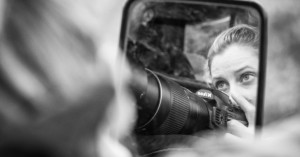
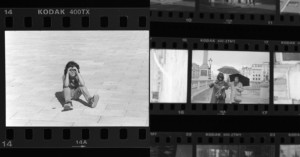
Lee has often worked without a specific project in mind, simply making pictures of what he saw, in order, as Garry Winogrand said, to see what it looked like photographed. This way of working led him to look at his contact sheets (of which there have been an astonishing number) to find out what was there that he might not have expected. His shadow, and more clearly defined versions of himself, turned up with regularity. At some point early on Lee realized that he was making self-portraits along with many other photographs that were defining a new landscape for all of us who saw his work. There is a great lesson in this for photographers of today who dedicate themselves to one project or another, failing to understand that the best work might come from an obsession with the medium rather than the personally oriented choice of what might be done with it. Lee always has a camera with him and is constantly making pictures. How much better the work of today might be if all the young and dedicated photographers took up this habit.
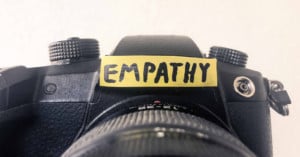
If you’re in a creative rut and can’t think of a “project” idea, don’t worry — just be obsessed with photography itself and constantly be ready to photograph what interests you.
KEH has published a helpful primer on memory cards that describes the different types, common error codes you might come across when using them, and how to take care of them:
Memory cards are quite sturdy and commonly expected to work through one million read/write/erase cycles. The weakest part of the card is the connectors however, and should withstand around 10,000 insertions/removals into a camera or card reader.
No matter which type of card (CF I&II, SD, XD, SM, MS, etc.) your camera takes, it’s a good idea to format it on a regular basis. While it may not happen often, these little cards of information can fail and reach the end of their life unexpectedly. To keep your card in good health, format it in the camera from time to time. (I format my card after every major download). This clears up the card and erases all of the data. Of course make sure that you have downloaded and saved onto a computer all of the files on the card before formatting.
Since the number of insert/remove cycles a card can handle is far less than the number of read/write cycles, it’s very important to handle your cards gently in order to prolong their lifespan.
Here’s a short video in which renowned American photographer Mary Ellen Mark shares some thoughts on photography and iconic photographs. Her advice for aspiring documentary photographers:
If you love it and you really want to do it, then you must do it because you’ll never forgive yourself for not doing something you cared about or you believed in, if you don’t do it now.
So I’ve been shooting some shows for some of the choral groups on campus at my school, and I’ve started to notice a trend: people make some stupid faces when they are singing. They can range from an approaching sneeze to a full-on O-face. Read more…
Here’s an excellent video tutorial by photographer Peter Hurley on how to improve your portrait photographs by focusing on the jawline of your subject. It’s a simple technique that can drastically improve the quality of your images.
The beautiful light painting photo you see here was created using steel wool (here’s a tutorial on the technique). Basically, you fix some steel wool on the end of a rope, set it on fire by rubbing a 9V battery against it, and then swing it around to fling sparks all over the place. While it’s becoming a pretty common photo project, it can also be hazardous to your lens’ — and your body’s — health. Jon Beard, the photographer behind this photo, learned the hard way. See that thick yellow line in the upper right hand corner? That’s one of the bits of burning metal striking his $2,000 Nikon 14-24mm f/2.8G lens. Read more…
Here’s a short and sweet video in which Chicago-based food photographer Stephen Hamilton shares some tips on how to take photographs of food using your smartphone. One tip is to use a white napkin as a makeshift reflector to fill in some of the shadows in the shot.