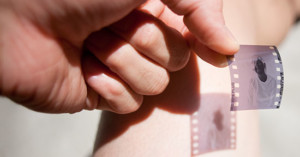
Lomo shooter wn7ant came up with a neat way of turning instant film photos into one-of-a-kind business cards. After printing out his business card design onto a transparency, he cuts it out and sticks it onto an Instax film cartridge. To create a new card, he simply takes a picture — the contact information on the transparency is printed onto every photograph!
Well, that was fast. Just a week after opening up its Photovine photo sharing app to the public, Google is now planning to kill it off, along with its second — and not-yet-launched — app Pool Party. Google is planning to focus its photo-sharing efforts on Google+, and will be shutting down Slide, the company behind the apps, which Google acquired last August for $200 million. The Slide employees were developing the apps independently, which explains why they were being made for iOS initially and not Google’s Android. If you’ve already begun using Photovine, you’ll have a few months to preserve your data from the service before it’s shuttered.
In the future, after you print photos onto paper using your camera, you’ll be able to scan them and share them on Flickr using your mouse. At CES earlier this year, LG showed off an amazing new mouse that lets you quickly scan images and documents by simply waving the mouse over them. Now it’s available — if you live in the UK, you can buy one from Dabs for £90 (~$150).
Photographer Murray Fredericks took sixteen solo trips over eight years to the center of Lake Eyre in Australia, the largest lake in the country and one that forms salt flats every year when the water evaporates. These salt flats provide a perfectly flat, featureless landscape that extends to infinity in every direction, and allow for beautiful abstract photographs. Read more…
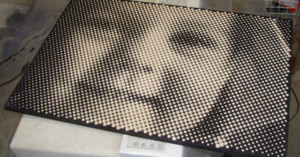

We may soon live in a world where the photographs in newspapers and magazines move like they do in Harry Potter — that is, if newspapers and magazines are still around in a few years.
Photographer Mitchell Feinberg wanted to continue shooting 8×10 large format once his Polaroid stockpile runs out, so he decided to create his own 8×10 digital back. He spent over a year looking for a manufacturer and designing the back, and shelled out enough money to buy a good-sized house:
The development and production of two backs (I wanted to have a spare) was equal to the cost of a good size house – before the housing crash. I know it sounds insane, but the financials on it are not so bad: I used to shoot on average 7.5 Polaroids per photo, and I shoot between 400 to 500 images a year. That’s at least 3000 Polaroids. At 15 bucks a pop. Or about 50K per year, minimum. Polaroid was at one point my highest single cost.
Now he’s the owner of the world’s largest color capture back (two of them, in fact), which shoots 10MP photos. He uses it to shoot test shots before using film for the final captures.
JPEGmini is a new image compression service that can magically reduce the file size of your JPEG photos by up to 5 times without any visible loss in quality. ICVT, the Israeli company behind the service, explains how the technology works in an interview with Megapixel:
Our technology analyzes each specific photo, and determines the maximum amount of compression that can be applied to the photo without creating any visual artifacts. In this way, the system compresses each photo to the maximum extent possible without hurting the perceived quality of the photo.
Austrian photographer Andreas Franke chose an interesting photo exhibition location for his project “Vandenberg: Life Below the Surface“: a shipwreck 93-feet underwater. It makes sense though — the project consists of photos Franke took of the wreck last year and subsequently turned into surreal composite photos containing people. The images, encased in 3mm thick plexiglass and mounted on stainless steel, were attached to the ship using magnets that don’t damage the ship or affect the sea life. Read more…
On Monday we reported that Fujifilm is planning to release a smaller and cheaper version of the popular X100 called the X50. The photo here shows the camera listed in a Promaster catalog, spotted by a person over on the Something Awful forums. The $600 12MP camera is shown to have a fixed f/2 28-112mm (35mm equivalent) manual lens and a “wide and bright optical viewfinder”. Read more…
After the dissolution of the Soviet Union in 1991, photographer Alexey Titarenko observed how St. Petersburg streets that used to be lively and filled with joyful people had suddenly turned dark and gloomy, with people confused, malnourished, and worn out. He decided to capture this change by shooting the streets at slow shutter speeds, turning the downtrodden crowds into shadowy figures. He titled the resulting project “City of Shadows“. Read more…