Posts Published in April 2010

Impossible Project Sets Up Shop in NYC

Impossible Project Sets Up Shop in NYC impossiblestore

In March, The Impossible Project announced that it had successfully brought Polaroid film back from the dead, releasing the new PX100 and PX600 instant films. Next up: a physical store in New York City.

The Impossible Project has just announced a new retail and exhibition space in New York City called “The Impossible Project Space”, located on the 5th floor at 425 Broadway. In addition to selling film and gear, the space will display works from “The Impossible Collection”, which is modeled after the world-famous Polaroid Collection and features work created on Impossible Project film.

There’s going be a grand opening party from 3pm-8pm on April 30th, so if you’re a Polaroid lover, it might be a fantastic way to connect with other enthusiasts.

(via PDNPulse)


Image credit: Photograph by The Impossible Project

Nikon Announces New 200-400mm f/4 Lens

Nikon Announces New 200 400mm f/4 Lens nikon200400

If you have deep pockets, Nikon has a wonderful new $6,999.95 lens for you. They’ve just announced the new Nikon AF-S 200-400mm f/4G ED VR II, a super telephoto lens for sports, nature, and travel photographers. Nikon claims that the latest Vibration Reduction technology, VR II, provides the equivalent of an extra four stops of light, which is one stop more than the previous version of this lens released in 2003. Additional improvements include Nikon’s proprietary Nano Crystal Coat, which reduces ghosting and flaring, and Automatic Panning Detection and an Active VR Mode, which allows the lens to be used at unstable locations such as in a moving vehicle.

The old lens is still being sold for ~$6,000 online, but you can expect the price to plummet once this lens is available in late May 2010. For more information on this lens, check out the press release put out by Nikon.

Apollo 11 Launch at 500 Frames per Second

This amazing video by Spacecraft Films shows the July 16, 1969 launch of the Apollo 11 mission that landed the first humans on the moon. The camera was rolling at a whopping 500 frames per second, allowing the first 30 seconds of the launch to be slowed down into this 8-minute narrated video of pure awesomeness.

(via Boing Boing)

Taylor Swift Markets New Sony Cyber-shot

Taylor Swift Markets New Sony Cyber shot DSCTX7L 1 copyCountry-pop darling Taylor Swift has joined the growing list of camera-toting celebrity spokespersons. Swift’s partnership with Sony hit the limelight in January during CES2010, when Swift joined in the Sony press event to announce her use of Sony 3D technology during her current tour.

In a commercial released today, Swift demos the iSweep Panorama feature on the new Sony TX7 Cyber-shot. According to a Sony press release, the ads will air tonight on NBC, FOX and CW, likely targeting  a younger, primarily female demographic — though as the commercial suggests, she’s got a pretty broad fan base.

The camera boasts a number of other noteworthy features including a Carl Zeiss lens, “Exmor R” CMOS censor, HD video, and a touch screen, but Sony says Taylor Swift fans can get extra excited over the limited edition version with the singer’s signature engraved onto the camera.

However, the camera comes at a steep price of $400, which is considerably pricey for point-and-shoots. That’s nearly the cost of six tickets to see Taylor Swift in concert.

Upcoming Sony EVIL Camera Spotted in an Asian Pub

Upcoming Sony EVIL Camera Spotted in an Asian Pub sonyevilpub

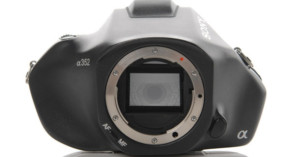
Someone spotted a wild version of Sony’s upcoming EVIL camera, the NEX3, at a pub in Asia recently and anonymous sent the photographs to the blog Sony Alpha Rumors. This comes just a week after an iPhone 4G prototype was found in a California bar, purchased by gadget blog Gizmodo for $5,000, dissected, and published.

The photographs show the camera (labeled NEX-3) with a 16mm f/2.8 “pancake” lens, which supposedly has image stabilization built in to make capturing video smoother. They also reveal an external flash mounted to the camera via a proprietary hot shoe system. Both this camera and its sibling, the NEX-5, are expected to have 14-megapixel Sony ExmorHD sensors, though the NEX-5 reportedly boasts HD-video capability, while the NEX-3 will be limited to 720p.

Sony’s upcoming cameras are meant to challenge the Micro Four Thirds system cameras made by Panasonic and Olympus, which also feature electronic viewfinders and interchangeable lenses (EVIL). The rumor is that Sony will be announcing these cameras officially on May 11th, and that they will be “aggressively priced” compared to Micro Four Thirds systems.

Here’s a tip for those working for companies that make gadgets: leave the prototypes and not-yet-unveiled devices at home when going to drinking establishments.

Blending the Pencil with the Camera

Pencil Vs Camera! is a wonderful series of photographs by Belgian photographer and painter Ben Heine in which he blends his pencil sketches with photographs to create new realities:

Blending the Pencil with the Camera pencilcamera1

Blending the Pencil with the Camera pencilcamera2

Blending the Pencil with the Camera pencilcamera3

Blending the Pencil with the Camera pencilcamera4

Blending the Pencil with the Camera pencilcamera5

Heine tells us,

Pencil vs. Camera! is the continuation of many years of graphic research. These pictures show not only the battle between photography and drawing, but also between reality and imagination. I think this work can lead to many different forms of expression, because it gives a clear message while traveling into surreal worlds in the same time.

To see more of Heine’s work, check out his Flickr photostream.


Image credits: Photographs by Ben Heine and used with permission

Comparing Digital Imaging Technology to the Human Eye

Comparing Digital Imaging Technology to the Human Eye 2855661699 9fcf338712

There’s an interesting discussion going on over at the DPReview forums regarding how the human eye compares to the technology we have in digital cameras.

Here are some of the findings that were compiled from various sources on the web:

  • Sensor size: 22mm in diameter
  • Resolution: 576 megapixels
  • Sensitivity: 1 – 800 ISO
  • Focal length: 22mm – 35mm
  • Aperture: f/2.1 – f/8.3

Another interesting idea that came up was the possibility of using the human eye as the lens and sensor for future imaging devices:

Maybe future “cameras” will actually link to your eyes – since the eyeball is such a great lens, who knows? Getting signal from the eye is the trick – would require a surgical implant or a means of reading brainwaves. Maybe that’s 200 years out – similar time [frame] the Mayo clinic is talking about for correcting double/triple vision.

Perhaps in the future we’ll all be documenting our lives at 576 megapixels through our eyes and ears, and storing the photos and videos on petabyte external hard drives at home.

What do you think of this discussion? Is there anything that jumps out at you as being wrong, or do you agree with the comparison for the most part?


Image credit: Eye (please add some funny TAGs) by Michele Catania

Homebrew Scanner Captures 2.5D Photos

Homebrew Scanner Captures 2.5D Photos homebrewscanner

Photography and electronics enthusiast Michal Zalewski recently built a simple scanning device using a diode laser and custom gearbox that allows him to create 2.5D images when used with a Canon 5D Mark II. These are regular photographs that are enhanced with accurate per-pixel depth information.

Here’s an example Zalewski gives of a regular photograph and its scan data:

Homebrew Scanner Captures 2.5D Photos 25dimaging

Cameras used for everyday photography do not record any information about how far away things in the photograph are. They simply record what they “see”. A 2.5D camera would allow you to capture photographs with apertures (i.e. a large depth of field), and then decide the focus and depth of field afterward in post-processing.

For an example of what this means, check out this interactive demonstration with chess pieces where you can click the image to bring the area into focus.

Could this be the next step in the evolution of photography?

Aluminum DSLR Attachment for Left-Handed Shooting

Aluminum DSLR Attachment for Left Handed Shooting lefthandedshooter

If you can’t shoot right-handed, or need to shoot left-handed for some reason (i.e. demonstrating something in a photo with your right hand), you can simply flip your camera over and use your pinky finger to press the shutter. Problem is, this ergonomically unfriendly grip is hard to do, and puts your camera at risk of slipping out of your hand. Instructables member bertus52x11, the same guy behind the PVC pipe camera support, has clever hack that solves this problem.

His solution is to attach a bent aluminum strip to the tripod mount that allows your thumb to grip the camera more firmly. So, if you break your arm like bertus52x11 did, this is a clever way to keep on shooting!

Take photographs with just your left hand (via Lifehacker)

Tour the World in 80 Stop-Motion Seconds

This amazing video by Romain Pergeaux and Alex Profit shows a journey around the cities of the world in 80 seconds through stop-motion. It was shot with a Sony HX5V compact camera, and shows 640 different photographs at 8 photographs per second. A special rig was also used to show a physical globe with pins in every shot, and the photographs were taken over the course of only 3 weeks. From the official website for the video, it looks like a viral promotional video for Sony’s camera, but it’s a pretty awesome effort nonetheless.